
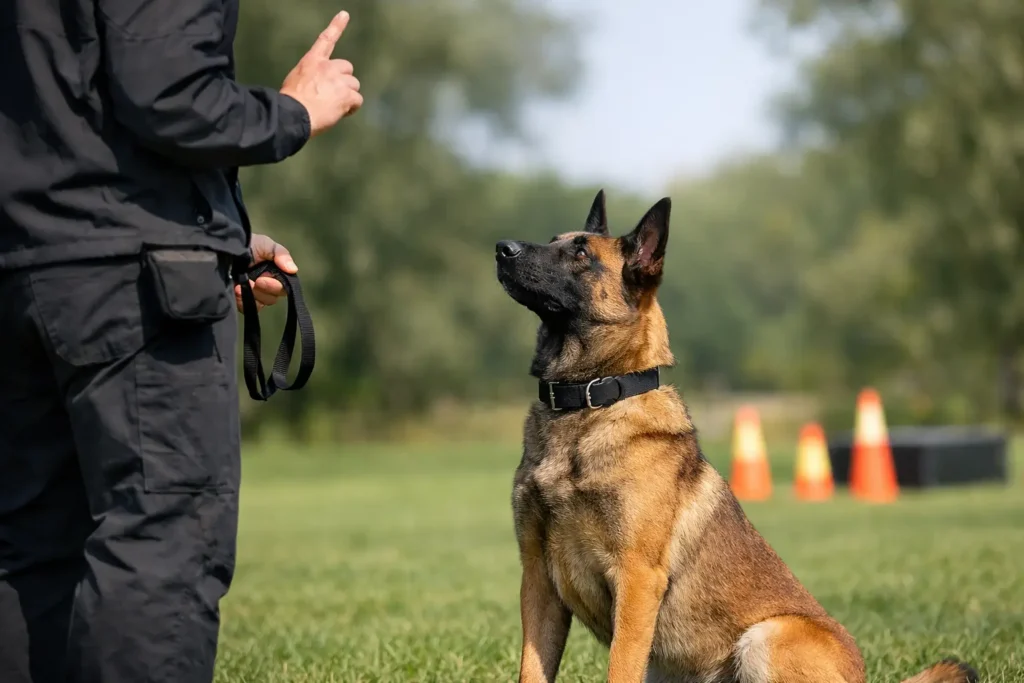
A dog’s value is easiest to see in the quiet moments – at the front door when guests arrive, beside a stroller on a walk, under a restaurant table, or settled calmly while the household moves around them. That is where advanced obedience training commands matter most. Not as a performance, but as the difference between a dog you manage and a dog you can truly live with.
For families and professionals seeking both companionship and peace of mind, obedience at an advanced level is less about showing what a dog can do and more about trusting how that dog will behave. A well-trained dog should feel composed in the home, clear in public, and responsive under pressure. That standard requires much more than a basic sit and stay.
What advanced obedience training commands really mean
Many people hear the phrase and picture a highly driven sport dog running through routines. That is not the benchmark most households need. In a family setting, advanced obedience training commands should create steadiness, clarity, and control in everyday life.
At this level, commands are expected to hold up with distance, distraction, and duration. The dog is not simply responding in a quiet training space. The dog is responding when children are moving, when a door opens unexpectedly, when another dog passes, or when travel and routine changes introduce stress.
This matters because the true purpose of obedience is not mechanical precision. It is reliability. A dog that listens only in ideal conditions is not advanced. A dog that remains composed in real-world environments is.
The commands that shape daily life
The most valuable advanced commands are often the least dramatic. A disciplined heel, a long down, a reliable place command, and a clean recall create the structure that allows a dog to integrate into refined home life.
A true heel is not simply walking near the handler. It is calm, attentive movement without pulling, forging, or drifting. For households that travel, entertain, or spend time in public spaces, this command becomes a quality-of-life feature. It allows the dog to move with the family rather than create friction around every outing.
A down command with duration is equally important. It gives the dog an off switch. In practical terms, that means the dog can remain settled during dinner, while children play nearby, or when a service professional enters the home. It is one of the clearest signs that a dog has learned patience, not just compliance.
Place may be the most useful command in a modern household. It teaches the dog to go to a defined location and remain there until released. When taught properly, it creates calm at thresholds, during family gatherings, and in moments where the dog needs structure without isolation. Instead of constantly correcting a dog, the family has a clear, reliable way to direct behavior.
Recall carries a different kind of weight. It is not just convenience. It is safety. A dependable recall can interrupt poor decisions before they become dangerous ones. But here too, standards matter. A recall is only meaningful if it works around distractions, not just when the dog feels like returning.
Why advanced obedience matters more for protection-capable dogs
When a dog has any level of deterrence or protection training, obedience is not optional. It is the foundation that makes every other capability responsible and livable.
The right dog should not feel intense or unstable in the home. It should feel easy to live with. That ease comes from advanced control. The dog understands thresholds, impulse control, environmental neutrality, and handler direction. The family is not wondering what the dog will do next because the dog has been taught how to exist calmly within household life.
This is where many people get misled. They assume protection is the defining feature. In reality, for most discerning families, the defining feature is control. The dog’s ability to settle, to respond immediately, and to remain clear-headed in stimulation is what creates confidence.
A dog that is affectionate with children, composed with guests under guidance, and fully manageable in public offers a level of reassurance that a reactive or overly sharp dog never can. Strength without control is a liability. Stability with control is what belongs in a family environment.
Advanced obedience training commands in the real world
The real test of training is whether it transfers into ordinary life. That means the dog can hold position while luggage is being moved, remain neutral in a hotel lobby, walk through crowded environments without anxiety, and settle in a home office without constant redirection.
For executives, business owners, and families with active schedules, that reliability is not a luxury. It is what makes ownership practical. A dog may be beautifully trained in a formal session and still be difficult to live with if that training does not generalize beyond repetition.
This is why polished obedience looks understated. The dog is not creating a spectacle. The dog is simply where it should be, doing what it has been asked to do, with minimal stress on the household.
There is also an emotional benefit that should not be overlooked. Predictability changes how a family experiences the dog. Instead of second-guessing whether the dog can handle visitors, travel, or daily transitions, they can relax into the relationship. The dog becomes part of the rhythm of the home.
What separates polished obedience from rehearsed obedience
Not all advanced training is equal. Some dogs appear highly trained in controlled demonstrations but lack consistency in changing environments. Others are pushed for precision at the expense of calm temperament. Neither approach serves most households well.
Polished obedience should feel natural. The dog responds promptly, but not nervously. The dog is attentive, but not frantic. The dog can work when asked and settle when not needed. That balance is far more valuable than flashy routines.
It also depends on the dog’s temperament. Not every dog is suited for the same level of expectation, and not every dog belongs in a family protection role. Strong training cannot compensate for unstable nerves, poor social judgment, or the wrong household match. This is one reason selective placement matters so much. The command set may be similar from dog to dog, but the right outcome depends on the individual dog’s character and the family’s lifestyle.
At High-Class K9, that distinction matters because the goal is not simply to present a trained dog. The goal is to place a dog that can live elegantly inside the client’s real life, with training that supports both security and companionship over the long term.
What owners should expect after placement
Even a fully trained dog benefits from consistency after placement. Advanced obedience does not mean the dog requires constant drilling, but it does mean the family should understand how to maintain standards clearly and confidently.
This usually looks less technical than people expect. It involves using commands consistently, reinforcing structure at home, and understanding how to guide the dog through new environments. The dog already knows the work. What matters is that the household supports the same expectations.
This is also why ongoing stewardship is so valuable. Families do not just need a dog that arrives trained. They need the confidence to live with that dog properly. Small adjustments in handling, routine, and communication often make the difference between good results and exceptional long-term integration.
There are trade-offs to acknowledge. A dog trained to this standard is not casual in the way an untrained pet may be. There is structure. There are expectations. But that structure is precisely what creates freedom. The dog can accompany the family more places, settle more easily, and move through life with greater trust.
Choosing the right outcome, not just the right commands
For a serious household, the question is not whether a dog knows advanced commands. The better question is what those commands produce. Do they create a dog that is calm with children, composed with guests, steady in public, and reliable when it matters? Do they support an environment where affection and security can coexist without tension?
That is the standard worth looking for. Not exaggerated intensity. Not kennel-style management. Not a dog that performs beautifully for a trainer and creates stress for the family.
The right advanced obedience training commands should give shape to a dog’s daily behavior so thoroughly that the training almost disappears. What remains is the feeling discerning owners want most – a companion who is easy to trust, easy to live with, and ready when needed.