
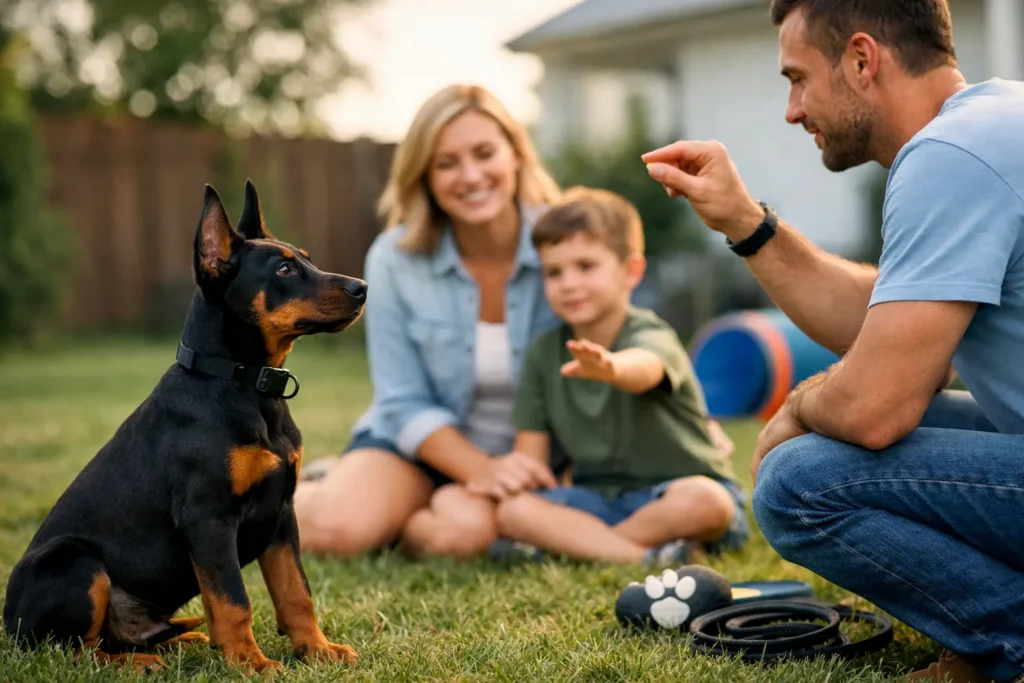
A puppy who can sit on cue is pleasant. A puppy who can settle during dinner, stay composed at the front door, ignore distractions in public, and look to the family for direction is something else entirely. That is where advanced puppy training begins to matter – not as a luxury, but as the foundation for a dog that can move through daily life with confidence, control, and ease.
For families who value both companionship and peace of mind, the real goal is not tricks. It is household reliability. The puppy should be affectionate without becoming demanding, alert without becoming reactive, and responsive without feeling pressured. Early training shapes those outcomes long before a dog is physically mature.
What advanced puppy training really means
Many people hear the phrase and picture a highly technical program built around precision obedience. In practice, advanced puppy training is more refined than flashy. It is the process of teaching a young dog how to live well in a home, respond under distraction, and develop the emotional stability that makes future training possible.
At this stage, the dog is not being asked to perform like a finished adult. That would be unrealistic and, in many cases, counterproductive. A puppy is still developing physically and mentally. The better approach is to build habits that will later support advanced obedience, travel confidence, social stability, and dependable behavior around family routines.
That distinction matters. A puppy can learn to heel in a quiet driveway and still fall apart when guests arrive. A dog can perform commands in a training session and still struggle to settle in a busy household. Real progress shows up in ordinary moments – when the dog can stay calm around children, recover quickly from stimulation, and accept direction without conflict.
Why advanced puppy training matters early
The first year is where patterns become identity. If a puppy rehearses pulling, barking, door rushing, overexcitement, and environmental insecurity, those habits do not simply disappear with age. They become more entrenched, and larger dogs make small mistakes feel much more significant.
Early advanced work helps shape judgment as much as obedience. The puppy learns that thresholds are approached calmly, guests do not need to be managed by the dog, and novel places are not a reason to panic or overreact. Just as important, the family learns how to communicate clearly and consistently.
This is one of the most overlooked parts of the process. Training is never just about the dog. It is also about whether the household can maintain standards without turning daily life into a correction-heavy routine. The best training creates a dog that is easy to live with, not one that requires constant management.
The skills that matter most
In a premium household setting, the most valuable skills are often the least dramatic. Place training is a strong example. A puppy who can relax on a designated bed while the family works, entertains, or eats is learning self-control in a practical form. That single behavior supports calmer greetings, smoother mealtimes, and better impulse control across the board.
Reliable recall matters for obvious reasons, but so does how the puppy responds to environmental pressure. Can the dog disengage from distractions? Can it recover after being startled? Can it walk through a hotel lobby, a neighborhood sidewalk, or a busy front entrance without becoming chaotic? Those are not small details. They define whether a dog can integrate naturally into a refined lifestyle.
Leash manners, structured socialization, neutral behavior around strangers, and calm vehicle travel also belong in this conversation. A young dog does not need to greet everyone or investigate everything. In fact, many families are better served by a puppy who learns to remain composed and attentive rather than socially impulsive.
Advanced puppy training and temperament
Training can improve behavior, but it does not replace temperament. That is a critical truth, especially for households seeking long-term confidence from their dog. A puppy can be taught routines, but deep nerve strength, environmental stability, social balance, and clear-headedness are not created through wishful thinking.
This is where selectivity becomes essential. Some puppies are naturally more resilient, more thoughtful, and easier to guide. Others may be sweet but softer under pressure, quicker to overstimulate, or less naturally suited for demanding environments. Good training helps both, but it does not make them equal.
That is why serious guidance matters early. The right program is not simply asking, “Can this puppy learn commands?” It is asking, “What kind of adult dog is this puppy likely to become, and what household will bring out the best in that dog?”
For families who want a dog that may eventually grow into more advanced household responsibility, that question is central. The future starts with genetic quality, stable temperament, and the discipline to avoid pushing a puppy into roles it is not ready for.
What families often get wrong
The most common mistake is confusing stimulation with progress. More outings, more strangers, more noise, and more exposure do not automatically produce confidence. Poorly timed or excessive exposure can create insecurity just as easily as avoidance can.
The second mistake is chasing performance before maturity. A puppy may look impressive when drilled hard, but polished routines can hide weak foundations. If the dog has not learned calmness, frustration tolerance, and trust in guidance, obedience can become brittle. It works until life becomes unpredictable.
The third is inconsistency inside the home. Families sometimes expect formal reliability in public while allowing disorder in daily routines. If the puppy can rush doors, ignore boundaries, demand attention, and practice impulsive behavior indoors, those habits follow the dog everywhere else.
Advanced puppy training works best when standards are elegant and consistent. Clear expectations, calm repetition, and thoughtful progression generally outperform intensity.
How advanced training should feel in daily life
The right training does not make a puppy robotic. It makes the dog more available to the family. There is more freedom because there is more trust. The puppy can accompany the household more often, settle more easily, and move through changing environments without creating tension.
That is a meaningful difference for executives, families with children, and privacy-conscious homeowners. A well-started dog should add reassurance to daily life, not friction. The family should not feel as if they are managing a project. They should feel guided, supported, and confident in what their dog is becoming.
This is also why founder-led placement and stewardship matter in a premium setting. The most successful outcomes usually come from a thoughtful match, realistic expectations, and ongoing support as the dog matures. At High-Class K9, that long-view approach reflects the difference between selling a trained dog and guiding a family into the right long-term fit.
When advanced puppy training leads to more
Not every puppy is meant for the same future, and that is a good thing. Some dogs are best developed into exceptional companions with polished obedience and strong household reliability. Others may have the temperament, confidence, and composure to support more serious future roles.
The mistake is assuming those paths should look identical at the start. A young dog with greater working potential still benefits from the same essentials – neutrality, stability, environmental confidence, engagement with handlers, and reliable control. In other words, the future is built on the same civilized foundations that make a dog enjoyable at home.
For discerning families, this is often the most reassuring part of the process. True capability should never come at the expense of domestic suitability. A dog should be able to live in the home, travel well, remain affectionate with the family, and show discernment rather than instability. The advanced work that matters most is the kind that preserves harmony while increasing confidence.
Choosing the right standard
If you are evaluating advanced puppy training, look beyond the training field. Ask what the dog is like around guests, children, household noise, travel, thresholds, and quiet time. Ask how the puppy handles novelty and whether the training supports composure, not just compliance.
The best young dogs are not merely obedient. They are settled, attentive, and socially appropriate. They do not need to dominate a room to change how a family feels in that room. Their presence alone brings a sense of order.
That is the real value of advanced puppy training. It shapes a dog that fits the household with discretion, intelligence, and reliability from the start. And when those early standards are handled well, the result is more than a well-trained puppy. It is the beginning of a life with a dog you can truly count on.
A young dog does not need to do everything early. It simply needs to learn the right things well, with enough care to support the life it is meant to share with you.