
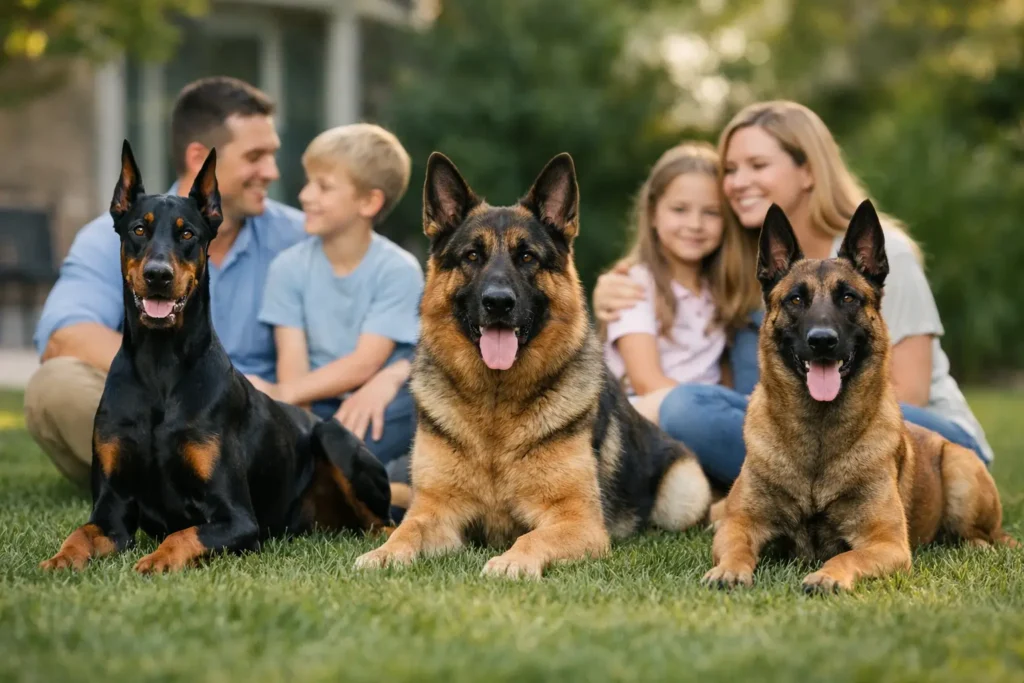
The wrong protection dog changes the feel of a home. Instead of adding confidence, it can add tension – too much intensity, poor social judgment, or a temperament that does not truly belong around children, guests, and daily family life. That is why the best protection dog for families is rarely the most intimidating dog in the room. It is the dog that can settle beside your children at breakfast, travel well, welcome normal life, and still provide meaningful deterrence and protection when it matters.
What makes the best protection dog for families?
For most households, the answer starts with stability. A family protection dog should not live on edge. It should be calm in the house, clear-headed in public, affectionate with its people, and responsive under pressure. Real protection begins with sound judgment, not theatrics.
This is where many buyers get misled. They assume protection ability is the defining trait, when in reality household compatibility matters just as much. A dog may have presence and working ability, but if it is too environmentally sharp, too handler-specific, or too intense for children and visitors, it may not be the right fit for a private home.
The best family protection dogs tend to share a few important qualities. They are social without being indiscriminate, watchful without being reactive, and confident without needing constant stimulation. They do not create problems to prove they can solve them. They know how to live quietly until there is a legitimate reason not to.
Breed matters, but temperament matters more
People often begin with breed, and that is reasonable. Certain breeds have a long history of excelling in protection work while still living well with families. German Shepherds, Belgian Malinois, Dutch Shepherds, Giant Schnauzers, and some lines of Dobermans are common starting points. Each can be impressive. None is automatically the best choice for every household.
German Shepherds are often the most natural answer for families who want a balanced companion. A good one offers presence, trainability, loyalty, and an easier off-switch than many more intense working breeds. They often blend well into family life when selected properly, which is why they remain a preferred choice for many protection households.
Belgian Malinois are exceptional dogs, but they are not ideal for every family simply because they are highly capable. They tend to be faster, sharper, and more demanding than many owners expect. In the right home, they are extraordinary. In the wrong home, they can feel like a professional tool brought into a domestic setting that does not suit them.
Dobermans appeal to buyers who value elegance, athleticism, and natural deterrence. The right Doberman can be affectionate, intuitive, and highly bonded to its family. Still, consistency in nerves, health, and household suitability varies widely, which makes individual selection especially important.
Giant Schnauzers can offer a compelling mix of seriousness and companionship, though they are often stronger-willed and less universally easy than buyers assume. Dutch Shepherds may be excellent in experienced hands, but they are rarely the first recommendation for a household seeking the smoothest possible integration.
In practical terms, breed narrows the field. Temperament makes the decision.
The best protection dog for families is trained for daily life
A family does not need a dog that looks impressive on a training field. It needs a dog that can move through normal routines with composure. That means the dog should be reliable in the home, neutral around expected distractions, and easy to handle in a refined, low-drama way.
A well-matched protection dog should understand boundaries, settle naturally, and respond to guidance without conflict. It should be comfortable riding in the car, accompanying the family, and existing around children’s activity, household staff, and invited guests when appropriate. Protection should feel integrated, not intrusive.
This is an important distinction. Some dogs are trained to perform. Others are trained to live with discernment. Families need the second category. The dog should not require a household to reorganize itself around instability or unpredictability. The value is not just in capability. It is in how naturally that capability fits into real life.
For this reason, advanced obedience and environmental confidence matter as much as controlled protection. A dog that cannot settle in ordinary settings is not giving a family more freedom. It is limiting it.
Why family composition changes the answer
A retired couple, a single executive, and a household with young children should not all receive the same recommendation. The best protection dog for families depends on who lives in the home, how often people come and go, and what kind of lifestyle the dog will need to support.
Homes with young children generally benefit from dogs with exceptional patience, softer household expression, and a dependable off-switch. Families with frequent entertaining need dogs that can distinguish between social activity and genuine concern. Clients who travel often may prioritize adaptability, ease in new environments, and composed public behavior.
There is also the question of owner experience. A highly capable dog may still be the wrong dog if it asks too much of the family’s handling style. Premium placement is not about selecting the most extreme option. It is about identifying the dog that gives the household confidence without adding unnecessary complexity.
That is why serious providers take consultation so seriously. The right dog is not chosen from a catalog of claims. It is matched through honest assessment of temperament, lifestyle, expectations, and long-term compatibility.
What to avoid when choosing a family protection dog
The biggest mistake is shopping for intensity. Many buyers, especially those concerned about security, are drawn to the dog that appears the strongest, fastest, or most imposing. Yet the dog that looks most dramatic is often not the one that lives best in a family environment.
Another mistake is relying too heavily on breed reputation without asking how the individual dog behaves in ordinary life. Protection is not only about what a dog can do under pressure. It is about how the dog feels in your home every day.
It is also wise to be cautious with sellers who focus almost entirely on aggression, bite work, or spectacle. That style of marketing may sound compelling, but discerning families usually need the opposite. They need restraint, clarity, and a dog whose first contribution is peace of mind.
Health and stewardship should not be treated as secondary issues either. A dog may be impressive on delivery day, but long-term success depends on sound structure, stable nerves, and continued guidance after placement. The relationship should not end once the dog arrives at the home.
So which breed is usually the strongest fit?
For many households, a well-selected German Shepherd remains the strongest overall candidate. Not because every German Shepherd is suitable, and not because other breeds cannot excel, but because the breed often offers the most balanced combination of deterrence, affection, trainability, and livability.
That said, there is no universal winner. Some families are better served by a Doberman with the right social temperament and household polish. Others may want the heightened capability and athleticism of a Malinois, provided their lifestyle and expectations truly support that level of dog. The right answer is often narrower and more personal than online rankings suggest.
At the premium end of this market, selection matters more than broad breed labels. High Class K9, for example, reflects a more thoughtful standard – one built around household fit, stability, and long-term success rather than a transactional idea of security. That difference matters when the dog is expected to live as both guardian and companion.
What families should look for before saying yes
A serious family protection dog should feel composed, not chaotic. It should show affection without clinginess, confidence without unnecessary edge, and attentiveness without constant scanning or reactivity. You should be able to imagine the dog in the calmest parts of your life, not only the worst-case scenarios.
Ask whether the dog feels natural in a home. Ask whether it can support your routines rather than dominate them. Ask whether the provider is thinking beyond the sale and into the reality of ownership. Families who make the best decisions usually focus less on image and more on the quality of daily life.
The best protection dog for families is not simply the dog that can defend. It is the dog that helps everyone in the home feel more settled, more secure, and more free to live well. That is the standard worth holding.