
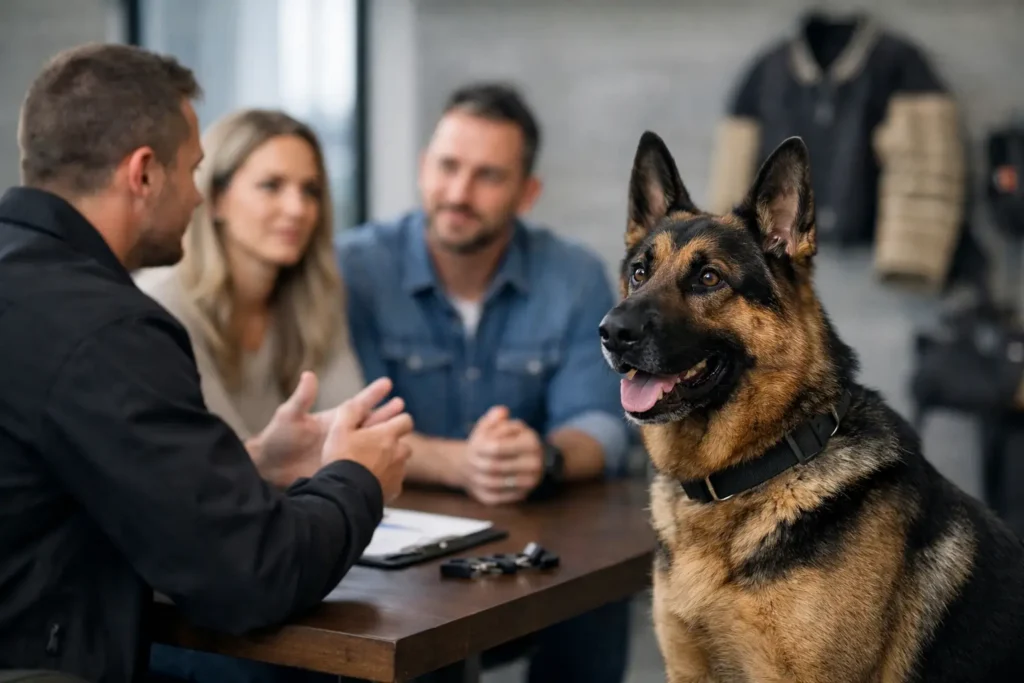
A protection dog may be impressive in a demonstration, but the real measure of quality is quieter: how the dog behaves beside your children at breakfast, settles during a dinner party, travels with confidence, and responds when something feels wrong. The best questions before buying a protection dog are the ones that reveal whether that dog can genuinely belong in your life, not simply perform on command.
For a discerning household, this decision is about more than security. It is about placing a loyal companion in the center of family life and trusting that the dog has the judgment, stability, and support behind it to make that role feel natural.
1. Is this dog the right temperament for my household?
Temperament is the foundation of a successful placement. A capable protection dog should be confident without being chaotic, alert without being suspicious of everyone, and affectionate without becoming possessive or needy. The dog must be able to distinguish between normal daily activity and a meaningful concern.
Ask how the provider evaluates social stability around children, guests, household staff, other dogs, unfamiliar environments, and everyday noise. A dog that is effective only in a controlled setting may not be the right fit for a busy home, frequent travel, or a social lifestyle.
The right answer will be personal, not generic. A family with young children, a single executive who travels often, and a homeowner with regular staff all need different qualities from the same broad category of dog.
2. What does everyday life with this dog actually look like?
Ask the provider to describe an ordinary week, not a highlight reel. How does the dog behave in the home? What is expected during walks, car rides, visitors, vacations, and time spent at restaurants or hotels? Can the dog relax when nothing is required of it?
A refined family protection dog should add confidence to your routine, not require your routine to revolve around managing it. There is always responsibility involved in ownership, of course. But a well-matched dog should feel composed and enjoyable to live with, rather than like a constant project.
This conversation also helps establish realistic expectations. Every dog has an individual personality, and a reputable provider should be candid about energy level, exercise needs, social preferences, and the household structure that will help the dog thrive.
3. How was the dog evaluated for real-world judgment?
Protection capability is only valuable when paired with sound judgment. Ask how the dog has been assessed outside a predictable training environment and how the provider determines whether the dog can remain neutral around normal people and activity.
The goal is not indiscriminate reactivity. It is controlled deterrence, dependable obedience, and a dog that can remain close, calm, and responsive to its family. A serious provider should explain this in clear terms, with an emphasis on the dog’s ability to disengage, settle, and follow direction.
Be wary of anyone who sells intensity as a substitute for stability. An intimidating presentation may look convincing, but the best family protection dogs are defined by clarity of mind and appropriate restraint.
4. Can I meet the dog in situations that resemble my own life?
A thoughtful placement process should give you a meaningful sense of the dog beyond a brief introduction. Ask whether you can see how the dog handles different environments, calm social interaction, obedience around distractions, and transitions between activity and rest.
If children, other pets, frequent visitors, or travel are part of your life, raise those subjects directly. The provider does not need to promise that every dog will suit every circumstance. In fact, honest guidance about fit is a strong sign of professionalism.
A selective placement process may occasionally lead to the conclusion that a particular dog is not your match. That is not a setback. It is the protection of a better long-term outcome for both the household and the dog.
5. What health information and guarantees are provided?
A premium placement should come with transparent health records and clear written terms. Ask what health testing has been completed, what veterinary documentation will be provided, and what the health guarantee covers. You should understand the dog’s known history and the provider’s standards before making a commitment.
It is equally wise to ask about the satisfaction guarantee. A serious program recognizes that compatibility matters. While no living animal can be reduced to a product specification, the provider should stand behind the care taken in matching the dog and supporting a successful transition.
Clarity matters more than broad promises. Read the written terms, ask what happens if an issue arises, and make sure you are comfortable with both the coverage and the process.
6. Who will guide us after placement?
The transition into a new home is where a great dog and a great match become a lasting partnership. Ask who will be available after delivery, how follow-up works, and whether you will have direct access to someone who understands your dog and your household.
Support should cover more than a quick handoff. Your family may need guidance as the dog learns your routines, settles into a new environment, and begins forming relationships with everyone in the home. Questions about travel, guests, home staff, boundaries, and changing circumstances can arise months later.
Long-term stewardship is especially valuable for families who want confidence without becoming experts in canine behavior themselves. The provider should remain an accountable resource, not disappear once the placement is complete.
7. What will my family need to do to maintain the dog’s training?
Even the most accomplished dog needs clear, consistent handling. Ask what your household will be expected to practice, what commands everyone should know, and how children and adults should interact with the dog in daily life.
The answer should be practical. You should leave the process knowing how to reinforce the dog’s manners, preserve reliable obedience, and create a calm home environment. For most clients, the ideal experience is not an elaborate training regimen. It is a few well-understood habits that protect the dog’s clarity and the family’s confidence.
Be honest about your lifestyle here. If several family members will share responsibility, ask how each person will be included in the transition. If you employ staff or travel regularly, discuss those realities early rather than trying to adapt after the dog arrives.
8. How do you match a dog to a client rather than simply offer what is available?
This may be one of the most revealing questions you can ask. A high-quality provider begins with your household, concerns, routines, preferences, and goals. The dog should be selected for the life you lead, not merely for appearance, pedigree, or a dramatic presentation.
Ask what the consultation process involves and who makes the final recommendation. Founder-led guidance can be particularly meaningful because it creates direct accountability for the placement. At High-Class K9, the purpose of this process is to make security feel integrated, personal, and sustainable from the first conversation through life at home.
9. What happens if our circumstances change?
Life rarely stays still. A child may leave for college, a new baby may arrive, a move may be planned, or your travel schedule may change. Ask how the provider advises clients through major transitions and whether ongoing support is available if the household’s needs evolve.
This question reflects a mature view of ownership. You are not only choosing a dog for the present moment. You are making a commitment to a living companion whose success depends on thoughtful decisions over time.
10. Do I feel pressured, or do I feel advised?
The final question is for yourself. A protection dog placement deserves careful consideration, and you should never feel rushed by scarcity claims, fear-based sales language, or vague assurances. The right advisor will welcome detailed questions, explain trade-offs, and be willing to say when a particular fit is not ideal.
The most reassuring dog is not necessarily the largest, most dramatic, or most forceful. It is the one whose steady presence fits your family so naturally that confidence becomes part of daily life. Choose the provider who treats that outcome with the seriousness it deserves.