
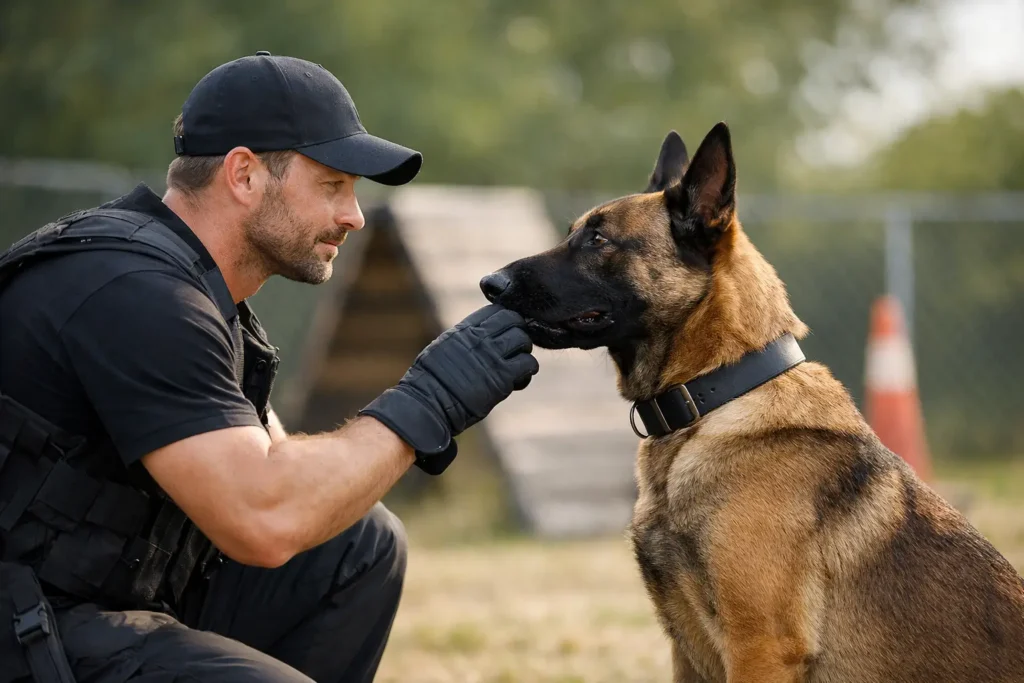
A protection dog should not change the feeling of home. The right dog still greets the children warmly, settles beside you during dinner, travels comfortably, and moves through daily life with quiet confidence. Controlled deterrence dog training is what makes that balance possible: a dog whose presence communicates capability without turning ordinary moments into security events.
For discerning families and professionals, that distinction matters. A dog that is merely reactive can create tension, liability, and unpredictability. A properly selected and trained protection companion offers something far more valuable: measured awareness, reliable obedience, and a calm presence that helps a household feel secure without living on edge.
What Controlled Deterrence Dog Training Means
Controlled deterrence is the ability to communicate that a dog is alert, capable, and under command without encouraging unnecessary confrontation. It is not about creating an intimidating animal for display. It is about developing composure and discernment so the dog can recognize when a situation is ordinary, when it warrants attention, and when it is time to return to a relaxed family role.
A well-trained dog does not treat every visitor, delivery driver, or unfamiliar sound as a threat. Instead, the dog remains observant and responsive to its handler. That self-control is central to a protection dog’s value in a private residence, on a walk, while traveling, or when accompanying a family in public.
The deterrent is often present before any overt action is needed. A confident, stable dog with clear obedience changes the calculation for someone with bad intentions. At the same time, that dog should be approachable and affectionate within the circle of people the family welcomes into its life.
Why Calm Presence Is More Valuable Than Constant Alertness
Many people picture protection in extremes: either a dog is a sweet companion or a serious security asset. In reality, the most successful family protection dogs are both, precisely because their training and temperament allow them to transition appropriately.
Constant suspicion is not protection. It is exhausting for the dog and disruptive for the family. A dog that barks at every passing car, pulls toward every stranger, or cannot settle when guests arrive may look vigilant, but that behavior does not reflect the steady judgment most households need.
Controlled deterrence favors a different standard. The dog should be neutral when neutrality is appropriate, attentive when awareness is appropriate, and responsive when the handler needs support. This creates a more natural life at home. Children can play in the yard, friends can visit, and the dog can accompany the family without becoming the center of every interaction.
That calm also builds credibility. The dog is not performing aggression for attention. Its confidence is evident in its posture, obedience, and ability to remain composed. For a family that values privacy, this is often the most sophisticated form of security: capability that does not need to announce itself.
The Foundation Starts With the Right Temperament
No training program can fully compensate for poor genetic stability or an unsuitable personality. The best protection companion begins with sound nerves, social clarity, environmental confidence, and an ability to recover quickly from novelty or stress.
A dog must be comfortable living closely with people. That means more than tolerating a household. It means enjoying affection, resting calmly indoors, adapting to routines, and remaining manageable around the normal movement and noise of family life. For homes with children, frequent guests, staff, or travel requirements, this level of stability is essential.
Temperament also determines whether a dog can make thoughtful distinctions. A dog that is fearful may react defensively. A dog that is overly impulsive may react prematurely. Neither quality serves a client seeking dependable personal or family security. The goal is a confident companion with the emotional balance to remain clear-headed in unfamiliar settings.
This is why thoughtful placement matters as much as training. A dog suited to a quiet couple’s city residence may not be the best fit for an active household with young children, frequent entertaining, and a large property. The right match considers the dog, the home, the family’s lifestyle, and the level of support the client expects after placement.
Obedience Gives Deterrence Its Boundaries
A protection dog is only as dependable as its ability to listen. Advanced obedience is not a separate feature from controlled deterrence dog training. It is the structure that keeps the dog’s awareness and capability accountable to the person responsible for it.
In daily life, this looks practical rather than theatrical. The dog comes when called, remains settled when asked, walks with control, respects boundaries, and disengages when the moment has passed. Those skills allow a family to enjoy the dog’s presence rather than managing it constantly.
Obedience also protects the dog. Clear direction reduces confusion in busy environments and gives the dog a reliable point of reference when a situation becomes unfamiliar. A confident handler-dog relationship is not built through force or tension. It is built through consistency, clarity, and trust.
For clients, this should shape how they evaluate a prospective protection companion. Ask less about dramatic demonstrations and more about the dog’s behavior between moments of intensity. Can the dog relax? Can it travel? Can it accept direction around distractions? Can it move from alertness back to calm? Those answers reveal whether the dog can truly live in a family environment.
What This Looks Like in Everyday Family Life
The benefit of controlled deterrence is most evident in ordinary moments. The dog may rest nearby while a parent works from home, accompany the family to a second residence, or remain composed as guests enter through the front door. The dog is present, engaged, and attentive without making the household feel restricted.
At night, the family gains another layer of confidence. A stable dog naturally notices changes in the environment and can alert its people without creating alarm over every routine sound. During travel, that same dog can provide reassurance in unfamiliar surroundings while remaining socially manageable in hotels, private aviation settings, or public spaces.
There is an emotional benefit as well. Families often want security because they have experienced a threat, increased visibility, or simply a growing concern for the people they love. The right dog does not feed that anxiety. It helps restore ease. Security becomes part of the home rather than a visible reminder of what might go wrong.
The Human Side of a Successful Placement
Even an exceptional dog needs a family that understands how to lead it. This does not require clients to become professional trainers. It does require clear guidance on routines, commands, household boundaries, travel, introductions, and how to maintain the dog’s confidence over time.
A premium placement should therefore extend beyond delivery day. The family needs to know who to call when life changes: a new home, a new child, a new caregiver, more travel, or a shift in household routine. Long-term stewardship protects the investment, but more importantly, it protects the relationship between the dog and the people it serves.
At High-Class K9, that philosophy centers on personal guidance and deliberate matching. The objective is not simply to place an impressive dog. It is to place a companion whose temperament, training, and presence support the way a client actually lives.
Choosing Confidence Over Intimidation
The strongest deterrent is not noise, spectacle, or a dog that appears difficult to control. It is a stable, affectionate companion with the training and discernment to remain calm until calm is no longer appropriate.
For the right family, that is the enduring value of controlled deterrence: a dog that protects the atmosphere of home as carefully as it protects the people within it.