
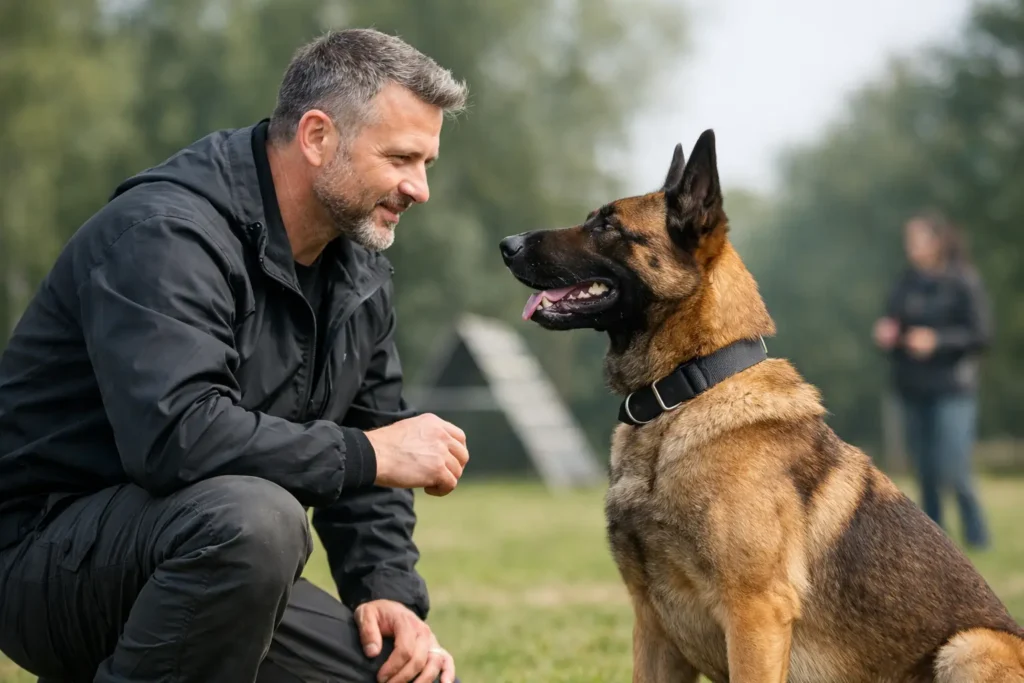
The right protection dog should make your home feel more settled, not more complicated. Knowing how to match protection dog temperament begins with looking beyond appearance, breed reputation, or a dramatic protection demonstration. The real question is simpler and more personal: what kind of dog can live comfortably within your household while providing the composed presence and reliable capability you expect?
For discerning families and individuals, protection is only part of the picture. The dog must also be affectionate with the people it knows, clear-headed in unfamiliar settings, responsive to direction, and comfortable participating in ordinary life. A thoughtful match creates companionship you feel and security you trust.
Protection Temperament Is About Stability, Not Aggression
A family protection dog does not need to be reactive, suspicious of every guest, or difficult to manage in public to be effective. In fact, those qualities can create stress for the household and limit the dog’s ability to travel, welcome trusted visitors, or settle at home.
The most desirable temperament is stable and discerning. A well-matched dog is environmentally confident, meaning it can remain composed around normal activity, new places, household sounds, and the movement of daily life. It should be social without being indiscriminate, alert without being anxious, and confident without needing to dominate every situation.
This distinction matters because deterrence begins long before a dog is called upon to respond. A calm, substantial dog with excellent obedience and an attentive bond with its family communicates capability. The best protection companion is not constantly proving itself. It is present, controlled, and prepared.
How to Match Protection Dog Temperament to Your Home
The selection process should start with your life, not a generic description of an ideal dog. A household with young children, frequent visitors, staff, or other animals has different needs than a couple who travels regularly or an executive who wants a close personal companion at home and on the road.
A premium placement should account for the full rhythm of your home: mornings, school pickups, weekends, entertaining, travel, and quiet evenings. A dog may be highly trained, healthy, and impressive, yet still be the wrong fit if its natural energy level, social boundaries, or need for engagement conflicts with how your family lives.
Consider the Household’s Pace and Energy
Some families want a dog that enjoys long walks, active weekends, and regular outdoor time. Others need a companion that can be active when invited, then settle quietly during work calls, dinners, or travel days. Neither preference is better, but it changes the right match.
Energy should not be confused with drive or protection ability. A dog can have the confidence and training needed for meaningful protection while remaining calm indoors. For many households, that off-switch is one of the most valuable traits. It allows the dog to move naturally from family life to focused work when the situation requires it.
Be candid about how much hands-on engagement your household can offer. A dog that thrives on constant activity may be an exceptional partner for one family and an unnecessary burden for another. Honest expectations protect both the family and the dog.
Evaluate Children, Guests, and Other Animals
Children bring noise, movement, friends, toys, and unpredictability. A suitable family protection dog should be patient, appropriately gentle, and able to settle amid normal family activity. This does not eliminate the need for supervision and clear household rules, but it does mean the dog should have the emotional steadiness to live comfortably with children.
The same principle applies to guests. Consider whether your home is quiet and private or whether you routinely host friends, relatives, colleagues, housekeepers, contractors, or caregivers. A protection dog should recognize the difference between a welcomed visitor and a genuine concern, with the family providing clear direction.
If other pets are part of the home, compatibility must be considered individually. A confident dog with excellent household manners may coexist beautifully with another dog, while a different pairing may require more management. General assumptions are not a substitute for evaluating the particular dog, the existing animal, and the home environment.
Define What Security Means to You
Clients often use the word protection to describe different concerns. One family may want a reassuring presence at a primary residence. Another may value a dog that can accompany them between homes, travel with them, or remain close during public-facing work. Someone else may be responding to a specific privacy or personal-safety concern.
The appropriate temperament depends on the role the dog will play. A dog intended to be an easygoing household companion with visible deterrent value may need a different social profile than one expected to accompany a client through a wider range of environments. The goal is not to select the most intense dog. It is to select the dog whose confidence, composure, and training suit the real situations you encounter.
Look for Clarity Under Pressure
Temperament is easiest to judge when a dog faces something unfamiliar or mildly challenging. The question is not whether the dog notices it. A good protection dog should be observant. The question is how it recovers, responds to guidance, and returns to a calm state.
A well-balanced dog does not unravel because of a loud sound, an unexpected movement, or a new environment. It may assess the moment, but it remains connected to its handler and capable of making good decisions. This clarity is central to both family compatibility and reliable protection.
During a thoughtful evaluation, pay attention to whether the dog can shift appropriately between engagement and relaxation. Can it greet a situation with confidence, then settle when asked? Does it accept direction without conflict? Is its affection natural and steady rather than overly needy or frantic? These qualities reveal far more about daily livability than a brief display of intensity.
Training Should Support the Dog’s Natural Character
Training can refine behavior, improve obedience, and establish clear communication, but it should not be used to force a dog into a role that conflicts with its underlying temperament. A dog that is naturally unstable, fearful, or overly reactive is not transformed into an ideal family companion simply because it has completed a training program.
The strongest placements pair advanced training with a dog that already possesses the right foundation: confidence, nerve, social stability, willingness to work with people, and the ability to settle. From there, training gives the family practical control. It helps the dog understand expectations in the home, in public, around guests, and in moments that call for heightened awareness.
This is also why a video alone cannot determine fit. Videos can show obedience and capability, but they cannot fully communicate how a dog feels in a household, how it responds to your family’s energy, or how naturally it fits into your routine. Personal consultation and careful assessment remain essential.
The Family Must Be Part of the Match
A protection dog is not simply placed into a home. It becomes part of a relationship system that includes every member of the household. One person may want a highly engaged walking companion, while another values quiet evenings and easy guest management. Children may need guidance on boundaries, and adults need confidence in handling and communicating with the dog consistently.
The right advisor asks direct questions about these details. They should want to understand your experience with dogs, your travel schedule, your property, your expectations for social life, and any concerns that prompted your search. This is not an obstacle to placement. It is the work that makes a placement successful.
At High-Class K9, thoughtful placement is built around that personal understanding. The objective is never simply to introduce an impressive dog. It is to identify a companion whose temperament supports your lifestyle, your confidence, and your long-term peace of mind.
Plan for Life After Delivery
Even an exceptionally matched dog needs a clear transition into its new home. The first days establish routines around feeding, rest, visitors, exercise, household boundaries, and communication. Ongoing guidance matters because family life changes. Children grow, travel increases, homes change, and new pets or staff may enter the picture.
Long-term stewardship gives owners a reliable source of support as those circumstances evolve. It also reinforces a truth that is sometimes overlooked: a protection dog’s success is measured over years of calm companionship, not by one dramatic moment.
Choose for the life you want to live every day. When temperament, training, and household expectations align, a protection dog becomes more than a security measure. It becomes a steady, affectionate presence that allows your family to move through life with greater confidence.