
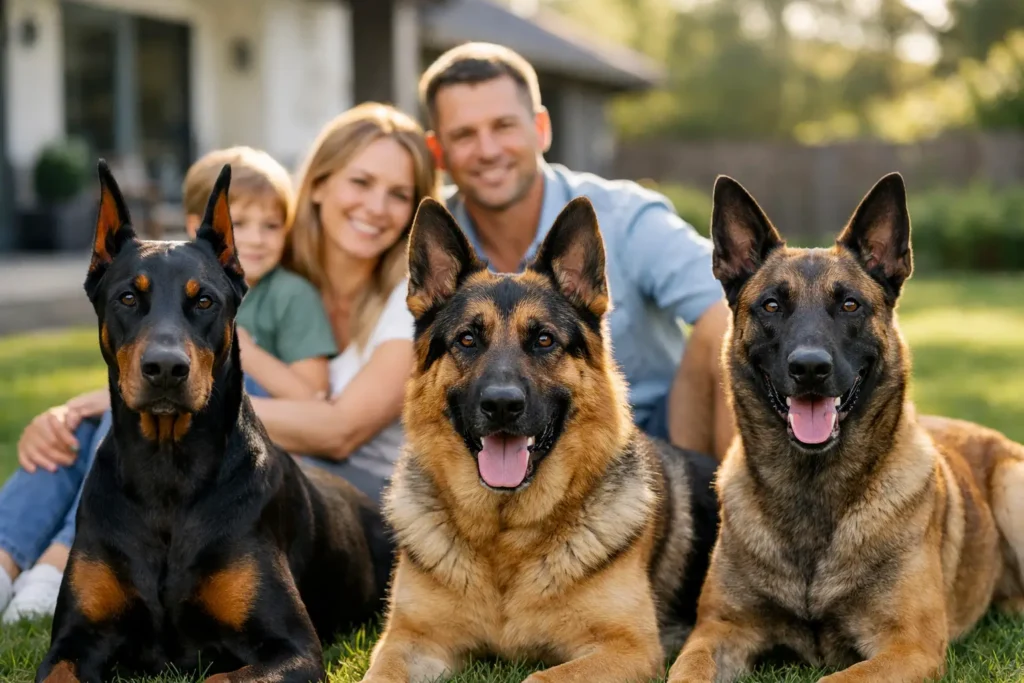
A protection dog should make a home feel more settled, not more complicated. The best household compatible protection dogs are composed enough to rest beside the family during a quiet evening, confident enough to accompany their owners in public, and discerning enough to recognize when a situation deserves greater attention. That balance is what separates a true family companion with protection capability from a dog that simply looks imposing.
For families who value privacy, consistency, and peace of mind, the decision is rarely about owning an intimidating dog. It is about welcoming a loyal, affectionate presence into daily life while having an added measure of confidence at home, on the road, and during the moments that feel uncertain.
What Household Compatibility Really Means
Household compatibility is not a superficial quality. A dog can be highly obedient in a controlled setting and still be a poor fit for a busy home. Real compatibility means the dog has the stability to live comfortably around normal family activity: children moving through the house, visitors arriving, household staff, deliveries, travel, changing schedules, and quiet downtime.
A well-matched dog does not need to create a scene to provide reassurance. Its presence, attentiveness, and calm confidence are often the first and most valuable layer of deterrence. The dog should understand how to settle, when to engage with the family, and when to remain neutral. This is particularly meaningful for households that entertain, travel frequently, or maintain more than one residence.
The goal is not constant vigilance. It is a companion that moves naturally through the family’s life while remaining responsive and dependable when guidance is needed.
Affection and discernment can coexist
Many prospective owners assume they must choose between a warm family dog and a serious protection companion. In a thoughtfully selected dog, those qualities are not opposites. A stable dog can be deeply affectionate with its own people while showing appropriate reserve around unfamiliar circumstances.
That distinction matters. An overly suspicious dog can make routine life exhausting. A dog with no discernment may be sociable but offer little meaningful confidence when an encounter turns uncomfortable. The right temperament sits in the middle: loving without being needy, alert without being reactive, and confident without being difficult to manage.
The Daily Life Test for a Family Protection Dog
The most useful question is not, “What can this dog do?” It is, “How will this dog live with us?” A premium protection companion should fit the rhythms that already define your household, rather than require the household to reorganize around the dog.
Consider an ordinary week. There may be school mornings, guests for dinner, a contractor at the gate, a late return from the office, and a family trip on the calendar. A household-compatible dog should be able to transition between these environments with poise. It should be comfortable relaxing in the home, riding in a vehicle, walking in public, and taking clear direction from its owners.
Children are an especially important part of the evaluation. Every family has its own energy level, routines, and expectations around dogs. A thoughtful placement considers the children’s ages, their experience with dogs, the home’s layout, and the level of adult involvement available. No dog should be viewed as a substitute for attentive parenting or responsible supervision. The right companion, however, can become a steady and affectionate part of family life.
The same principle applies to other animals. A household with an existing dog, cat, or other pet requires a more detailed conversation about temperament and introductions. Compatibility is personal. A dog that thrives in one environment may not be the best choice for another, regardless of its training or pedigree.
Why Temperament Matters More Than Appearance
Protection capability is often judged by appearance, but appearance alone says very little about how a dog will function in a refined household. Size, breed reputation, and a commanding silhouette may offer visual deterrence, yet they cannot replace sound nerves, emotional stability, and a clear, manageable temperament.
A dog that is easily overstimulated, fearful, or unpredictable can create more concern than comfort. By contrast, a stable dog is able to assess its environment without becoming consumed by it. It can remain calm around normal activity and respond appropriately when its family needs direction, space, or support.
This is why selective placement is essential. The most suitable dog is not necessarily the largest, the most dramatic, or the most outwardly intense. It is the dog whose temperament, energy, social confidence, and lifestyle needs align with the people it will live beside.
For an executive who travels often, ease in new settings may be central. For a family with young children, a patient and grounded disposition may take priority. For a homeowner seeking confidence during late-night arrivals, a naturally watchful but composed companion may be the better fit. These are meaningful distinctions, and they should guide the placement from the beginning.
Training Should Support Life, Not Dominate It
The value of advanced training is seen in the moments when it quietly supports everyday life. A dog that responds reliably to its family can be included more easily in routines, travel, and social situations. Clear obedience gives owners a practical way to guide their dog, while controlled deterrence and situational protection provide an additional layer of security when circumstances call for it.
Still, training alone does not create a successful placement. A dog’s behavior in a new home depends on the relationship that develops after arrival. The family must understand the dog’s routines, communication style, boundaries, and needs. The dog, in turn, needs consistency as it learns the household, its people, and its place within the home.
That is why the delivery and transition period deserve real attention. White-glove placement should include more than handing over a leash. It should give owners the confidence to bring the dog into their daily lives with clear guidance and realistic expectations.
At High-Class K9, the emphasis is on the long view: matching the dog to the home, helping the family understand the transition, and remaining available as the relationship develops. That stewardship is especially valuable for clients who expect a high level of discretion and personal accountability.
Questions Worth Asking Before Placement
A serious consultation should go beyond preferences for breed, color, or size. Those details may matter, but they are secondary to how the dog will actually live. Be candid about your household’s schedule, children, other pets, travel patterns, visitors, staff, and prior dog experience. The more complete the picture, the better the match can be.
It is also wise to discuss what protection means to you. Some clients want a visible, confident companion for daily walks and travel. Others are concerned about privacy at home, a public-facing career, or a specific change in their personal security needs. A clear conversation helps establish whether a particular dog’s temperament and presence are appropriate for that concern.
Ask how the dog behaves in ordinary settings, not only in demonstrations. How does it settle indoors? How does it handle guests who have been properly introduced? What support is available after placement? Are health history, guarantees, and expectations clearly documented? These answers reveal more about long-term suitability than any single performance moment.
The Right Dog Changes the Feeling of Home
A household protection dog should not make a family feel as though it is living inside a security operation. The best placements feel far more natural than that. There is a dog resting near the kitchen while the day begins, joining the family on a walk, traveling with confidence, and offering a steady presence when the home is quiet.
That sense of ease is earned through careful selection, thoughtful preparation, and continued guidance. It depends on choosing a dog that can offer affection without sacrificing awareness, and security without disrupting the warmth of family life.
The right companion does more than stand watch. It gives a household the freedom to live fully, welcome the people they trust, and return home with a deeper sense of confidence.