
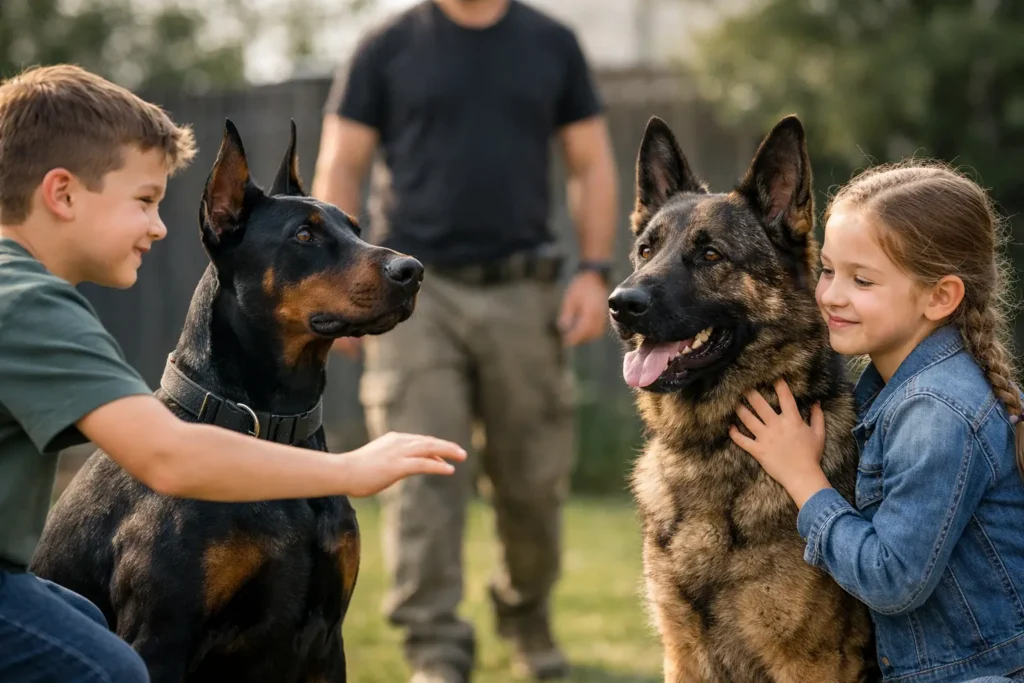
The first family meeting with a professionally developed protection dog should feel calm, not dramatic. To prepare children for a protection dog, parents should begin before the dog arrives by setting expectations around respect, routine, and adult leadership. The goal is not to make children fearful of the dog or overly focused on its protection role. It is to help them understand that this is a highly trained companion who needs clear, consistent treatment to settle naturally into family life.
A well-selected dog can bring comfort, affection, and an added sense of confidence to a home. But the relationship is built at home, in ordinary moments: a child walking past the dog’s bed, a family returning from school, visitors arriving for dinner, or everyone settling in for the evening. Those daily interactions shape trust far more than a single formal introduction.
Prepare Children for a Protection Dog Before Arrival
Children do best with simple, honest expectations. Before the dog comes home, explain that the dog is not a toy, a bodyguard for playtime, or a pet they can manage independently. He is a living animal with training, preferences, and a need for personal space. Adults will be responsible for feeding, handling, directing, and supervising the dog.
That conversation should be adjusted to the child’s age. Younger children generally need a few memorable rules and steady reminders. Older children can understand more about why consistency matters: a dog learns from patterns, and mixed messages can create confusion. A family protection dog should not have one set of rules with adults and another with children simply because children find exceptions amusing.
It is useful to decide household expectations in advance. Will the dog be invited onto furniture? Which rooms are off limits? Where will he rest when the household is busy? What should children do when the dog is eating, sleeping, or enjoying a chew? These are not small details. Predictable routines help a dog understand the home, and they give children practical ways to participate without being asked to make decisions beyond their maturity.
Parents should also explain that affection is not the same as connection. Children often want to hug, climb on, crowd, or constantly call to a new dog because they are excited. A better relationship comes from calm engagement, respectful touch when appropriate, and allowing the dog to approach rather than demanding attention. The dog should never have to tolerate behavior that would make any animal uncomfortable.
Start With Calm, Adult-Led Introductions
The arrival day is not the time for a room full of excited relatives, neighborhood children, and competing instructions. Keep the first meeting quiet and structured. One adult should guide the process, while children are introduced in a measured way and allowed to observe the dog’s body language and settling process.
Children can be taught to stand calmly, speak in normal voices, and let the dog become familiar with them without pressure. Rather than asking a child to immediately pet or play with the dog, allow the interaction to develop at the dog’s pace. This gives everyone a better start than forcing a warm welcome for the sake of a photograph.
For very young children, active supervision means more than being somewhere nearby. An adult should be close enough to notice changes in energy, redirect excitement, and prevent a child from cornering, startling, or interrupting the dog. Even a stable, professionally trained dog needs thoughtful management around unpredictable child behavior. Training provides an exceptional foundation; it does not remove the family’s responsibility to guide daily life well.
The same principle applies when children have friends over. A familiar child who understands the household rules is different from a group of energetic visitors who do not know the dog or the home. Parents should plan for those situations rather than assuming the dog will automatically interpret every new social setting correctly.
Give Children Meaningful, Age-Appropriate Roles
Children often bond more successfully when they have a role, but the role should fit the child and the dog. A young child may help refill a water bowl with an adult present, participate in a calm grooming routine, or practice giving the dog space on his bed. An older, responsible child may be able to join an adult during a controlled obedience routine, using the same cues and standards the family has agreed upon.
What children should not do is take responsibility for situations that require adult judgment. They should not be expected to manage greetings at the door, correct the dog, handle unfamiliar people around the dog, or make decisions about access to spaces and resources. Leadership should remain clear. When adults handle the important decisions calmly and consistently, children can enjoy the companionship without carrying responsibility they are not ready for.
This distinction matters in premium family protection placements because the desired outcome is a dog who lives comfortably within the household, not a dog who is constantly asked to prove himself. Children should experience the dog as a steady companion: present during family routines, responsive to guidance, and allowed appropriate rest. The protection capability should support peace of mind in the background, not become the center of the family’s relationship with the dog.
Teach Boundaries Without Making the Dog a Mystery
Some parents react to a protection dog by creating too much distance. They tell children never to approach, never to touch, and never to engage. That can make the dog seem mysterious or intimidating, which is not helpful for a family companion. Others go too far in the opposite direction and permit unlimited access because they want an immediate bond.
The better approach is structured familiarity. Children should know when interaction is welcome, what gentle engagement looks like, and when the dog needs to be left alone. A resting place should be treated as the dog’s private area. Meals, chews, sleep, and illness or fatigue are all times when adults should be particularly attentive to space and supervision.
Use straightforward language. Instead of saying, “Don’t bother the dog,” explain, “When he is on his bed, we let him rest.” Instead of saying, “Be careful,” give a specific instruction: “Walk around him, not over him,” or “Ask an adult before you invite a friend to pet him.” Specific guidance is easier for children to follow and easier for parents to reinforce.
It also helps to avoid turning the dog into a security lesson for children. There is no need to speak in frightening terms or encourage children to test what the dog will do. A mature family conversation can acknowledge that the dog has advanced training and is there as part of the household’s overall sense of security. Beyond that, the emphasis should remain on respect, companionship, and good everyday behavior.
Build Reliability Through Everyday Family Life
The strongest family relationships are rarely built through special events. They are built through repetition. A dog learns who rises calmly in the morning, who respects his space, who follows the same routine at the door, and who gives clear guidance without frustration. Children learn, in turn, that the dog is not unpredictable when the adults around them create consistency.
Parents set the tone. If adults allow rough play one day, then scold the dog or child for the same behavior the next, neither receives a clear lesson. If adults become overly anxious whenever the dog and children are in the same room, children may absorb that tension. Calm supervision is more useful than nervous monitoring.
As the relationship develops, continue to check assumptions. A child may become more confident and start taking liberties. The dog may need additional quiet time after a busy week of travel, guests, or household activity. Family routines change with school schedules, holidays, and new visitors. Good ownership means noticing those changes and adjusting management before small issues become habits.
For families working with a thoughtful placement partner such as High-Class K9, continued guidance can be particularly valuable during this transition. Asking questions early is a sign of responsible ownership, not uncertainty. The details of a successful home life often matter more than families expect.
Let Trust Develop at the Right Pace
Children do not need to earn a dog’s affection by being loud, insistent, or constantly available. They earn trust through calm presence and predictable behavior. A dog who chooses to rest near a child reading, follows the family from room to room, or settles during an ordinary evening is often showing the kind of integration families value most.
Give that relationship time. Keep rules clear, keep adults responsible for leadership, and let every family member learn how to live respectfully with an exceptional companion. Done well, the dog becomes neither a spectacle nor a source of tension, but a reassuring part of the home’s daily rhythm.