
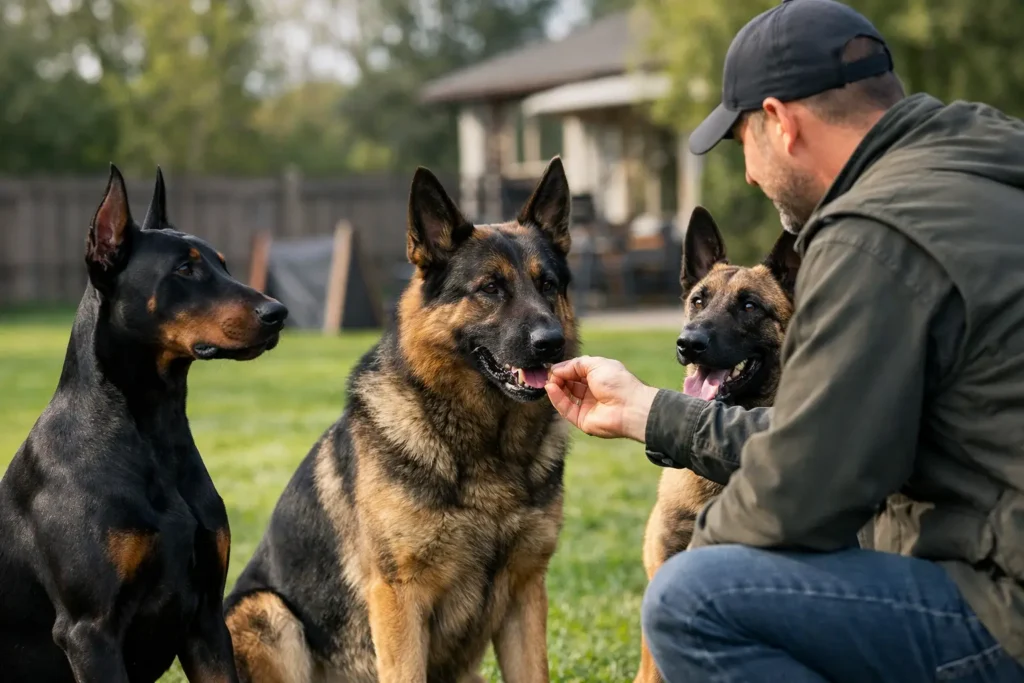
A protection dog can arrive at a new home with exceptional obedience, sound judgment, and a strong foundation for family life. Yet the first quiet morning after delivery often matters more than clients expect. The dog is learning where to rest, who gives direction, how the household moves, and what daily life will require. Protection dog stewardship after placement is the work of turning professional preparation into a calm, dependable relationship at home.
That work should feel purposeful, not burdensome. A well-developed dog is not asking the family to become professional trainers. He does need clear expectations, consistent handling, and thoughtful management while he learns his new environment. Professional training establishes capability. Everyday life determines how reliably that capability fits the people, routines, and pressures of a particular home.
Protection Dog Stewardship After Placement Begins at Home
The transition period is not simply an adjustment for the dog. It is the beginning of a shared language. A dog that has lived, trained, and traveled with experienced handlers now needs to understand the rhythms of your household: the school run, visitors at the gate, children playing, quiet evenings, work calls, travel days, and weekends away.
For the first several weeks, simplicity is a gift. Keep feeding, walks, rest, and structured interaction relatively predictable. Introduce new people, places, and family routines with intention rather than trying to show the dog everything at once. A calm start allows the dog to observe, settle, and learn what is normal in his new life.
This is especially relevant in busy homes. A protection dog should be integrated into family life, not isolated from it, but integration does not mean unlimited access from day one. Clear boundaries around furniture, doorways, meals, and resting areas help the dog understand his role without conflict or confusion. Structure creates confidence because the dog does not have to guess which behaviors are welcome.
The Relationship Is Built in Ordinary Moments
Families sometimes think of training as a scheduled session with commands and rewards. Those sessions matter, but a dog learns just as much from what happens between them. He learns when he waits calmly before going outside, when he settles while the family eats dinner, when he walks politely through a lobby, and when he remains composed as guests arrive.
Every interaction is a training session, whether anyone intended it to be or not. If pulling toward the front door occasionally results in greeting a visitor, the dog has learned that pulling can work. If calm waiting consistently earns access to the yard, car, or family activity, the dog learns patience and self-control. Small, repeated outcomes shape behavior more deeply than occasional corrections or a single formal lesson.
Leadership in this context is not forceful or theatrical. It is calm, fair, predictable, and earned through consistency. The dog should know who guides the pace of a walk, who decides when greetings happen, and who provides direction when the environment becomes stimulating. That clarity supports a relaxed companion. It also protects the reliability of the training that was carefully developed before placement.
Affection Works Best Alongside Expectations
A premium family protection dog should be affectionate and closely connected to the people he lives with. Affection is part of a healthy relationship, but it is not the entire relationship. Constant excitement, inconsistent rules, or allowing a dog to demand attention can create a different picture of family life than the one the dog needs to understand.
Offer warmth generously, while preserving moments of calm independence. Ask for a simple behavior before food, play, opening a door, or inviting the dog onto a designated resting place. These are not rigid rituals for their own sake. They create a pattern in which good things arrive through cooperation and composure.
Children benefit from this approach as well. They should be taught to respect the dog’s resting space, avoid climbing or crowding him, and involve an adult in higher-energy interactions. A stable dog can be wonderfully tolerant, but children and dogs both do best when adults create thoughtful boundaries. Respect is a family habit, not something the dog alone is expected to provide.
Preserve the Dog’s Confidence Through Management
A professionally developed protection dog should be socially stable and capable of moving through real life with composure. Still, confidence is not permission to put the dog in every situation without preparation. A crowded celebration, a contractor moving equipment through the house, a new caregiver, or an unfamiliar dog in a hotel hallway may require more guidance than an ordinary day.
Management is not a sign that a dog has failed training. It is responsible stewardship. Use a leash when introducing new environments, give the dog a quiet place to rest when household activity becomes excessive, and supervise interactions that have meaningful variables. This prevents poor rehearsals and gives you time to guide the behavior you want.
The right choice depends on the dog and the setting. Some dogs settle easily in the center of activity; others benefit from watching a new situation from a little more distance before joining it. Some households entertain frequently, while others value quiet privacy. The goal is not to make every dog respond identically. The goal is to read the individual dog honestly and make decisions that keep him successful.
Do Not Let Protection Become the Dog’s Entire Identity
The finest family protection dogs are companions first in daily life. Their value is not measured by how often they are asked to demonstrate protection skills. In fact, the strongest picture of a well-integrated dog is usually quite ordinary: resting near the family, traveling with composure, greeting appropriately when invited, and remaining attentive to his handler in unfamiliar settings.
Handler-directed protection capability should remain controlled, purposeful, and supported by professional guidance. Families should avoid encouraging suspicion, testing the dog with friends, or creating dramatic scenarios to see what he will do. Those choices can blur boundaries and teach the dog that ordinary social situations carry unnecessary tension.
A dog’s deterrent value often begins with his presence, confidence, and the visible partnership he shares with his family. The objective is not a dog that reacts to everything. It is a dog that remains clear-headed, responsive, and safe to live with.
Continued Support Protects the Original Investment
Placement is a transition, not an endpoint. Even a highly prepared dog may need help interpreting a new household, and owners may have questions once real life begins. An experienced advisor can often identify a small handling adjustment before it becomes an established pattern.
Reach out early when something changes. A move, a new baby, extended travel, household staff, a change in work schedules, or repeated visitors can alter the dog’s routine and expectations. Early guidance is usually easier and more effective than waiting until frustration develops. High-Class K9 approaches continued support as part of responsible placement because long-term success belongs to both the dog and the family.
Ongoing practice also matters. Short, accurate obedience work keeps communication clear and reminds the dog that familiar expectations apply in changing places. A few focused minutes during a walk, before a meal, or when entering the home can be more valuable than an occasional long session performed without consistency.
Let Time Do Its Work
Trust cannot be rushed, purchased, or created through affection alone. It grows as the dog sees that his family is steady: rules remain fair, guidance remains calm, and his needs are understood. Over time, the dog learns the sounds of the house, the personalities of the people in it, and the difference between ordinary life and a moment that deserves closer attention.
That is the real standard for stewardship after placement. Give the dog a life with clarity, companionship, and purposeful leadership, and he has the best opportunity to become what he was selected to be: a deeply trusted member of the family whose presence brings confidence without disturbing the life you value.