
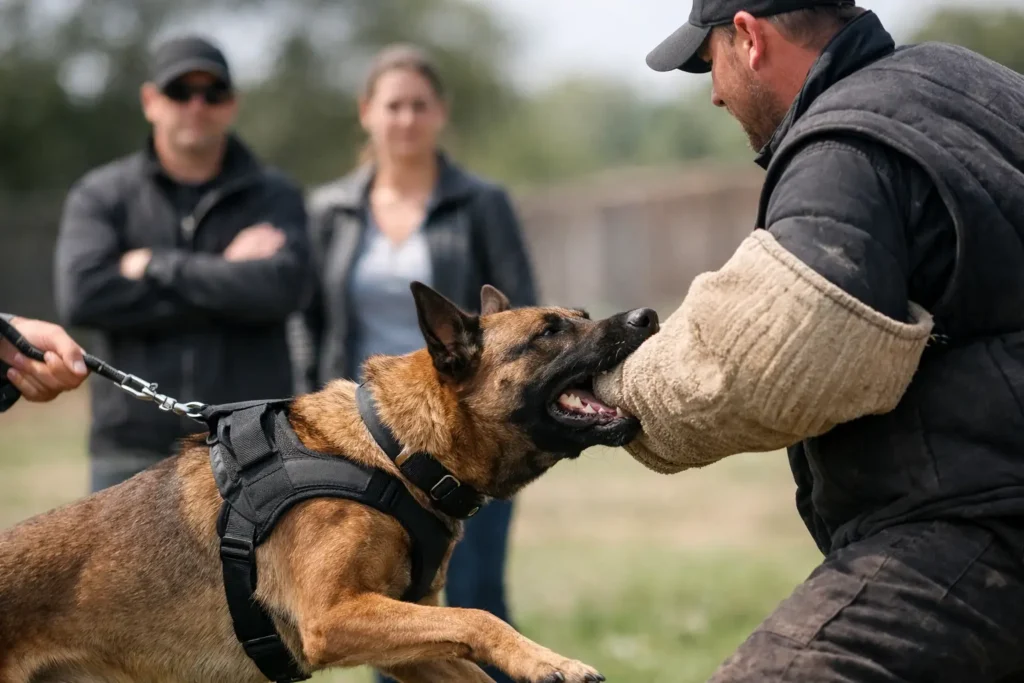
A family protection dog should not turn an ordinary evening at home into a security operation. It should greet trusted guests appropriately, settle beside the family during dinner, travel comfortably, and remain attentive without making daily life feel tense. Situational protection dog training is what makes that balance possible: a refined approach that teaches a dog to distinguish between normal life and a circumstance that requires controlled deterrence or protection.
For discerning families, executives, and public-facing professionals, this distinction matters. The objective is not a dog that reacts to every unfamiliar sound, delivery driver, or neighbor. It is a stable companion whose presence brings confidence, whose behavior remains composed, and whose protection capability is available when the situation truly warrants it.
What Situational Protection Dog Training Means
Situational protection dog training develops a dog that can operate with judgment, control, and clarity in the real environments where a family actually lives. The dog is taught to be observant and responsive to its handler while maintaining the calm temperament required for a home, vehicle, office, or travel setting.
A well-trained protection dog is not simply alert or imposing. Many dogs can bark at a door, become territorial, or appear intimidating. Those behaviors alone do not reflect reliable protection. In fact, a dog that is overly reactive can create more stress, more liability, and less freedom for its family.
The standard should be higher. The dog must understand the difference between a familiar visitor and a person behaving in a genuinely concerning manner. It must remain responsive when distractions are present, respond to direction under pressure, and return to a calm state once the concern has passed. This is controlled protection, not indiscriminate aggression.
The Difference Between Deterrence and Disruption
A dog with the right presence is often a meaningful deterrent before any situation escalates. Size, confidence, obedience, and calm attentiveness communicate something very different from anxious barking or chaotic behavior. For many households, that visible sense of security is the primary benefit.
The best family protection dogs do not need to perform constantly to make an impact. They create reassurance through their composed presence at the front door, beside the vehicle, during an evening walk, or while accompanying their family on a trip. Their behavior should feel natural and discreet, not theatrical.
Disruption begins when a dog’s reactions are difficult to predict or control. A dog that lunges at guests, cannot settle in public, guards family members from friends, or escalates around children is not offering the quality of protection most private households need. Situational training is designed to avoid that outcome by placing temperament and stability at the center of the dog’s preparation.
Why Temperament Comes Before Protection Work
No amount of training can fully compensate for a temperament that is unstable, nervy, excessively suspicious, or unable to recover from stimulation. The dog selected for a family protection role must have the confidence to remain clear-headed and the social stability to live closely with people.
That is especially important in homes with children, frequent visitors, household staff, other pets, or active travel schedules. A dog may need to move from a quiet residence to a busy airport environment, a hotel lobby, a school pickup line, or a family gathering. Each setting asks for adaptability, not intensity.
The right dog is affectionate without being possessive, alert without being anxious, and protective without becoming difficult to manage. This is why thoughtful placement matters as much as training. A strong dog for one household may be the wrong fit for another, even when both families value security.
The household shapes the right match
A quieter home with adults who travel frequently may call for a different temperament than a busy family residence with young children and regular social activity. The home’s layout, lifestyle, experience with dogs, travel expectations, and privacy concerns all influence the right recommendation.
A premium placement process should account for these realities before a dog is introduced to the family. The goal is not simply to place an impressive dog. It is to place a companion that can succeed in that particular home for years to come.
What Daily Life Should Feel Like
When situational protection is done well, the family experiences the dog first as a devoted companion. The dog should be comfortable relaxing in the home, riding in the vehicle, walking politely, and engaging warmly with approved family members. Its training should support freedom, not create a long list of restrictions.
That does not mean the dog is casual about boundaries. It means those boundaries are clear. A well-prepared dog knows when to settle, when to remain close, when to be attentive, and when to respond to its handler. This clarity helps the dog feel secure, which in turn helps the household feel at ease.
For a client who values discretion, the ideal protection dog does not announce itself unnecessarily. It remains composed in ordinary interactions while offering a serious layer of confidence when the environment changes. The family should not have to choose between a dog that is loving at home and one that provides meaningful security. The right placement is built to deliver both.
Training Is Only Part of the Equation
A dog’s long-term success depends on more than the preparation completed before placement. The family also needs a clear understanding of how to communicate with the dog, reinforce daily expectations, and preserve the structure that allows the dog to remain balanced.
This does not require turning the client into a professional trainer. It does require thoughtful onboarding, practical guidance, and support as the dog settles into a new routine. Small details matter: how the dog is introduced to visitors, where it rests, how it accompanies the family in public, and how household rules remain consistent across family members.
The adjustment period is an opportunity to establish trust on both sides. A dog that has been carefully prepared still needs to learn the rhythms, people, and expectations of its new home. Families benefit from working with a placement partner who remains accountable after delivery, rather than disappearing once the transaction is complete.
Consistency protects the training investment
Clear routines are not about making life rigid. They give the dog a reliable framework for understanding its role. When family members use consistent expectations and maintain calm leadership, the dog is more likely to remain relaxed, obedient, and responsive.
If a household’s routine changes substantially, ongoing guidance can be equally valuable. A new child, move, staff change, second residence, or increase in travel may require a thoughtful adjustment plan. Long-term stewardship recognizes that protection and companionship are not static needs.
Questions to Ask Before Choosing a Protection Dog
Before selecting a dog, prospective owners should look beyond dramatic demonstrations. Ask how the dog behaves around children, invited guests, other animals, and unfamiliar environments. Ask how it recovers after excitement, how it handles travel, and what support is available after it joins the household.
It is also reasonable to ask about health testing, written guarantees, and the process used to evaluate compatibility. A high-quality placement should be transparent about what the dog can do and equally candid about what responsible ownership requires. No dog should be presented as an automatic solution that removes the need for sound judgment and household awareness.
The most valuable question may be the simplest: Can this dog live beautifully within the life we already have? Security only feels like a luxury when it integrates naturally with the people, routines, and places that matter most.
High-Class K9 approaches that question with the care it deserves. The right dog should offer affectionate companionship in the quiet moments and composed confidence when life calls for more awareness. That is the standard worth seeking: protection that supports your lifestyle without ever taking it over.