
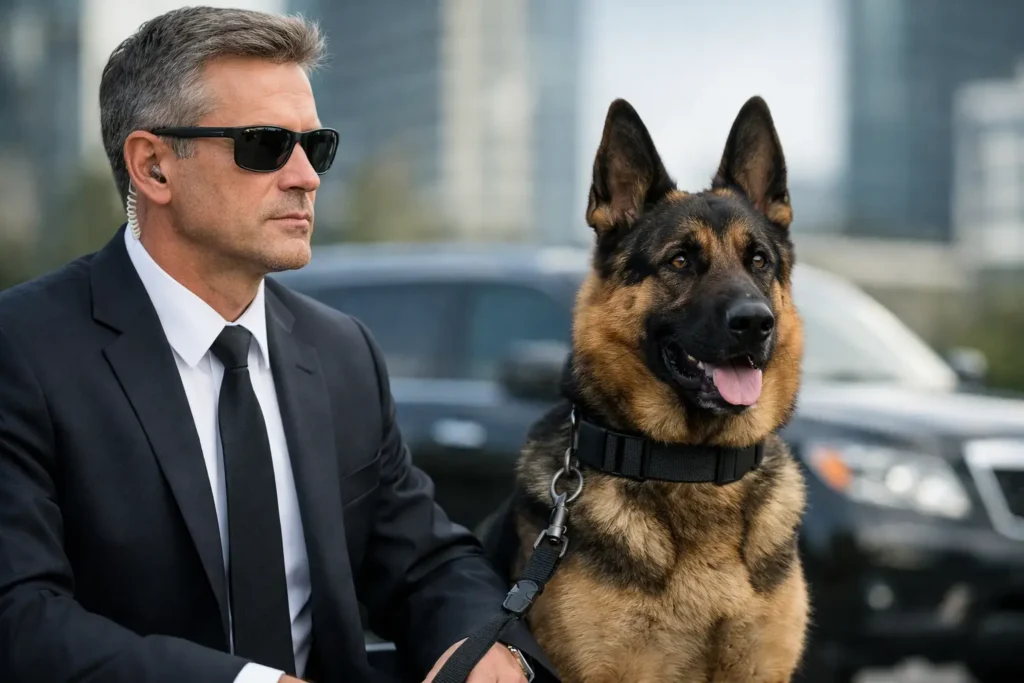
The difference shows up before anything ever happens. A well-selected protection dog changes the atmosphere around a home, a vehicle, or a family routine simply by being present. That is why executive protection dogs appeal to discerning households and professionals who want more than visible security. They want calm deterrence, trustworthy companionship, and a dog that fits naturally into daily life.
For many buyers, the phrase can be misleading. It suggests a dog trained only for high-pressure scenarios or public-facing assignments. In reality, the best executive protection dogs are not defined by spectacle. They are defined by stability. They live in the home, travel well, remain composed around family and guests, and provide confidence without turning everyday life into a security exercise.
What executive protection dogs are meant to do
At the premium end of the market, these dogs are not chosen for intensity alone. They are selected for judgment, clarity, and the ability to shift smoothly between affection and controlled deterrence. The goal is not to create a dog that feels on edge. The goal is to place a dog that feels settled, attentive, and reliable in real life.
That distinction matters. A dog can be powerful and still be unsuitable for a family or executive household. Some dogs have drive without the balance required for a polished domestic environment. Others may perform well in training settings yet struggle with travel, visitors, children, or the cadence of a normal home. Executive protection dogs should be capable of integrating into the household first, because a dog that cannot live well with the family will not deliver peace of mind.
In practical terms, these dogs are expected to offer several things at once. They serve as visible deterrents. They provide a reassuring presence at home and during movement. They remain obedient and manageable in public and private settings. Most importantly, they are companions people genuinely enjoy living with.
Why families and executives choose them
Some clients have a specific security concern. Others simply want to feel less exposed. A public-facing professional may spend time between offices, events, and travel. A family may want another layer of confidence at home without changing the warmth of the household. In both cases, the appeal is similar. They are not looking for a kennel asset. They are looking for a living, loving part of the family that also carries protective value.
This is where the right dog offers something technology cannot. Cameras record. Alarms notify. Gates delay. A well-trained protection dog observes, deters, and responds to presence in a way that is immediate and deeply intuitive. That does not make the dog a replacement for broader security planning. It makes the dog a uniquely personal layer within it.
There is also an emotional component buyers often recognize only after placement. The right dog does more than help people feel safer. It helps them feel more at ease in their own routines. School pickups, evening arrivals, time at home, and travel transitions can feel less vulnerable when a stable, trained dog is by your side.
The qualities that matter more than image
The market often rewards dramatic language, but serious buyers should look past it. The most valuable qualities in executive protection dogs are not aggression, size alone, or a flashy training demonstration. They are steadiness, environmental confidence, sociability with discernment, and the ability to live closely with people.
A premium protection dog should be affectionate without being needy, alert without being reactive, and obedient without feeling mechanical. The dog should move through the home with composure. It should be safe around children when properly supervised, appropriate with invited guests, and clear-headed in unfamiliar settings.
Health and nerve strength matter just as much as training. A dog with impressive skills but poor structure, weak recovery, or unstable behavior is not a luxury solution. It is a risk. The same applies to dogs that are overtrained for display but underprepared for actual household life. A polished placement depends on the whole dog, not one dramatic capability.
Executive protection dogs in everyday life
The strongest placements are the ones that feel natural within a week or two. The dog settles into the home, understands boundaries, and quickly becomes part of the family rhythm. That may mean resting near the kitchen while children move through the house, accompanying a couple on evening walks, or traveling calmly between residences.
This is the part many first-time buyers underestimate. Daily livability is not a minor detail. It is the foundation of long-term success. If the dog is difficult to manage, constantly overstimulated, or unable to relax, the protection value is overshadowed by stress. For affluent households in particular, the expectation is not merely safety. It is smooth integration.
That is why thoughtful placement matters so much. One family may need a socially confident dog that can move comfortably through an active household with regular visitors. Another may prefer a more reserved dog suited to a quieter estate or a client with a high privacy profile. Neither is automatically better. The right fit depends on lifestyle, travel patterns, home environment, and the owner’s comfort level.
How to evaluate executive protection dogs wisely
The first question is not, Can the dog protect? The better question is, Can this dog live beautifully in the environment where protection is needed?
That shifts the evaluation in the right direction. Buyers should consider how the dog behaves in the home, how it handles transitions, and whether it shows stable judgment rather than constant tension. A serious placement process should involve more than discussing breed and appearance. It should examine the client’s routine, household composition, travel habits, property layout, and expectations.
It is also worth paying attention to how a provider talks about the dogs. If the conversation centers on intimidation, extreme behavior, or theatrical demonstrations, that is often a sign the everyday side of placement is being neglected. A refined protection dog should not feel like a novelty or a weapon. It should feel like a trusted companion with meaningful capability behind that calm exterior.
Written assurances, health transparency, and direct accountability matter too. At this level, clients should expect clarity around the dog’s condition, suitability, and long-term support. The relationship should not end at delivery. The best providers remain invested because proper ownership is part of successful protection.
Why placement matters as much as training
Training creates ability. Placement determines whether that ability holds its value in real life.
This is where selective providers distinguish themselves from volume sellers. A dog can be highly trained and still be wrong for a particular household. Perhaps the environment is too busy, the family wants more social softness, or the client travels in ways the dog does not handle well. These are not minor mismatches. They shape the owner’s entire experience.
A founder-led, consultative approach tends to produce better outcomes because it treats the process as a match, not a transaction. The buyer is not simply choosing a dog. The provider is also evaluating whether the pairing supports long-term success. That selectivity protects everyone involved, especially the family and the dog.
For clients seeking a discreet, elevated security solution, this matters more than branding language ever will. A premium experience is not only about the quality of the dog. It is about the judgment behind the match, the education provided to the household, and the stewardship that continues after the dog arrives.
The trade-offs buyers should understand
Executive protection dogs are powerful additions to a household, but they are not effortless status symbols. They require responsible ownership, clear communication, and consistency. Even an exceptionally well-prepared dog benefits from structure and reinforcement in the new home.
There is also a difference between wanting a deterrent and wanting a dog integrated deeply into family life. Most clients want both, but priorities vary. A household with frequent events, staff movement, and constant visitors may need a dog with unusual social flexibility. A more private family may value reserve and closer bonding over broad sociability. Good guidance helps buyers understand those trade-offs before placement, not after.
It also depends on what peace of mind means to the client. Some want confidence at home. Others care equally about movement between locations or a companion that can travel comfortably and remain composed in changing environments. The right dog should support the client’s actual lifestyle, not an imagined one.
High Class K9 serves this space well because the focus is not just on canine capability, but on thoughtful household fit, discretion, and long-term stewardship. For the right client, that is where the real value lives.
The best executive protection dogs do not dominate a household. They settle it. They bring a rare combination of affection, presence, and confidence that clients can feel every day, not only in worst-case moments. When the match is right, security stops feeling separate from family life and starts feeling like part of it.