
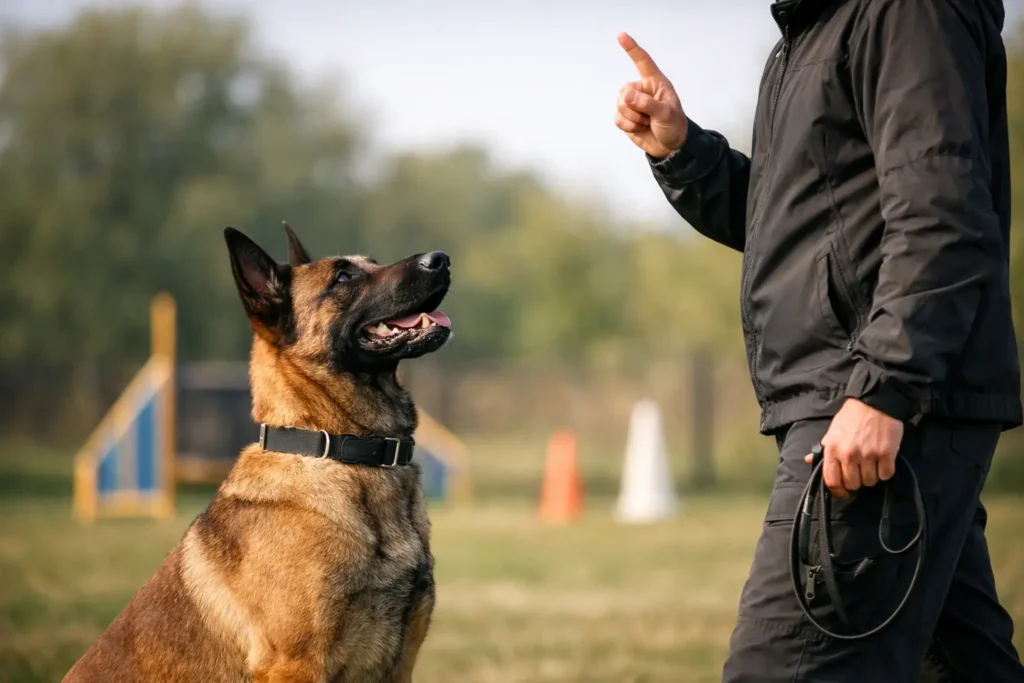
A dog who sits in the kitchen for a treat is one thing. A dog who remains composed at the front door, ignores chaos, travels well, settles in public, and responds immediately under pressure is something else entirely. That difference is the heart of what is advanced obedience training for dogs, and for the right household, it matters far more than flashy commands.
Advanced obedience is not about teaching a dog to perform for applause. It is about creating a companion who is reliable in real life. The dog understands expectations clearly, responds with consistency, and moves through daily family routines with calm control rather than friction. For families, executives, and security-conscious homeowners, that level of training is not a luxury in the casual sense. It is what makes a highly capable dog pleasant to live with.
What is advanced obedience training for dogs?
At its core, advanced obedience training for dogs is the next level beyond basic commands like sit, down, and come. The difference is not only in what the dog knows, but in how well the dog performs those skills across environments, distractions, and pressure.
A basic pet dog may obey in a quiet living room. An advanced obedience dog is expected to obey in the driveway, around visitors, near traffic, during travel, and when household energy changes suddenly. The training aims for steadiness, responsiveness, and clarity. In practical terms, the dog is not simply command-trained. The dog is lifestyle-ready.
That distinction is especially important for households that want both companionship and peace of mind. A dog can be affectionate and social, but if that dog becomes difficult to manage in stimulating situations, the household does not feel more secure. It feels more complicated. Advanced obedience closes that gap.
What advanced obedience looks like in daily life
For most discerning owners, the value of advanced obedience is seen in ordinary moments. The dog holds position when guests arrive instead of rushing the door. The dog walks calmly without pulling, forging, or scanning every distraction. The dog settles in the home with children moving around, accepts direction from the handler, and transitions smoothly from activity to relaxation.
This level of training usually includes reliable heeling, place command duration, structured recall, extended down-stays and sit-stays, off-leash responsiveness where appropriate, and strong impulse control. Just as important, the dog learns neutrality. That means not overreacting to other dogs, strangers, loud sounds, movement, or environmental pressure.
Neutrality is one of the most overlooked parts of a truly advanced dog. Many people focus on action, but refined training is often about restraint. A dog who does not need to react to everything is easier to trust, easier to travel with, and easier to integrate into a sophisticated household.
Advanced obedience is about reliability, not complexity
Some trainers present advanced obedience as a longer list of harder tricks. That can be misleading. Complexity alone does not create value. Reliability does.
A dog who can perform ten commands inconsistently is less useful than a dog who can perform five commands with excellent clarity under distraction. In a family setting, advanced obedience should support quality of life. It should reduce stress, improve communication, and create confidence between dog and owner.
This is where training quality matters. The strongest programs are not built around theatrics. They are built around repetition, accountability, environmental exposure, and a standard of behavior that holds up beyond the training field. That is why advanced obedience can never be judged by a short demonstration alone. The true test is how the dog lives.
Why advanced obedience matters in a protection dog
When families ask about personal or family protection dogs, obedience should never be treated as secondary. It is the foundation that makes any higher-level capability safe, appropriate, and manageable.
A dog with protection instincts but poor obedience is not a refined security solution. It is a liability. The right dog must be stable enough to live naturally in the home, affectionate enough to bond with the family, and obedient enough to respond immediately to direction. Protection without control is not sophistication. It is risk.
That is why advanced obedience matters so much in premium placement. The goal is not to place a dog that feels intense. The goal is to place a dog that feels composed, responsive, and trustworthy. The family should feel supported by the dog’s presence, not burdened by managing it.
In that sense, advanced obedience does more than improve manners. It creates the control structure that allows deterrence, confidence, and household ease to coexist.
What separates true advanced obedience from basic training
The clearest difference is proofing. A dog may understand a command in one setting and still fail to perform it when the environment changes. Advanced obedience requires training through those changes until the response becomes dependable.
That includes different handlers, new locations, social distractions, moving distractions, indoor and outdoor transitions, and emotionally charged moments. It also includes duration and accountability. A dog is not advanced simply because it can go into a down position. The dog must be able to remain there until released, even when something more interesting is happening nearby.
Another difference is handler experience. Basic training often assumes the owner will continue teaching the dog. With advanced obedience, especially in a premium companion or protection context, the dog should arrive with a much more polished behavioral framework already established. The owner still plays a critical role, but the foundation should be far beyond entry level.
The trade-off buyers should understand
Not every dog marketed as highly trained is the right dog for family life. Some dogs are trained with intensity that looks impressive in a demonstration but does not translate well into a home with children, travel, guests, and varied routines.
This is where discernment matters. Advanced obedience should produce control without creating a dog that feels brittle, anxious, overly sharp, or difficult to live with. A dog can be highly responsive and still be warm, stable, and social in the right settings. In fact, for most private households, that balance is the goal.
It also depends on the household itself. A retired couple in a quiet residence may need a different expression of advanced obedience than a public-facing executive who entertains often, travels regularly, and wants a dog that transitions smoothly between home, vehicle, and public environments. The training standard may still be high, but the application should be tailored.
What to look for if you are evaluating a dog
If you are considering a trained companion or family protection dog, ask simple but revealing questions. How does the dog behave when nothing exciting is happening? Can the dog settle? Can the dog remain neutral around guests? Does the dog transition smoothly from movement to stillness? Is the obedience visible only during a formal routine, or does it carry over into ordinary life?
You should also pay close attention to the relationship between dog and handler. Refined obedience does not look chaotic or combative. It looks clear. The dog understands the handler, the handler understands the dog, and both move with confidence.
At High Class K9, that standard matters because the right placement is not about selling a dramatic concept. It is about placing a dog that genuinely improves a family’s daily life while providing confidence you can feel.
Why advanced obedience is really about peace of mind
For the right client, advanced obedience is not primarily about commands. It is about trust. Trust that the dog will respond when asked. Trust that the dog can live comfortably inside a refined household. Trust that security does not have to come at the expense of companionship, travel, or normal family routines.
That is why this level of training carries real value. It supports the dog’s role as a calm presence, a social companion, a deterrent when needed, and a reliable member of the household. The best trained dogs do not make daily life feel more restrictive. They make it feel more settled.
If you are evaluating whether a dog belongs in your home, watch for the quality that matters most: calm control. That is usually where advanced obedience stops being a training term and starts becoming something far more meaningful – confidence you can live with every day.