
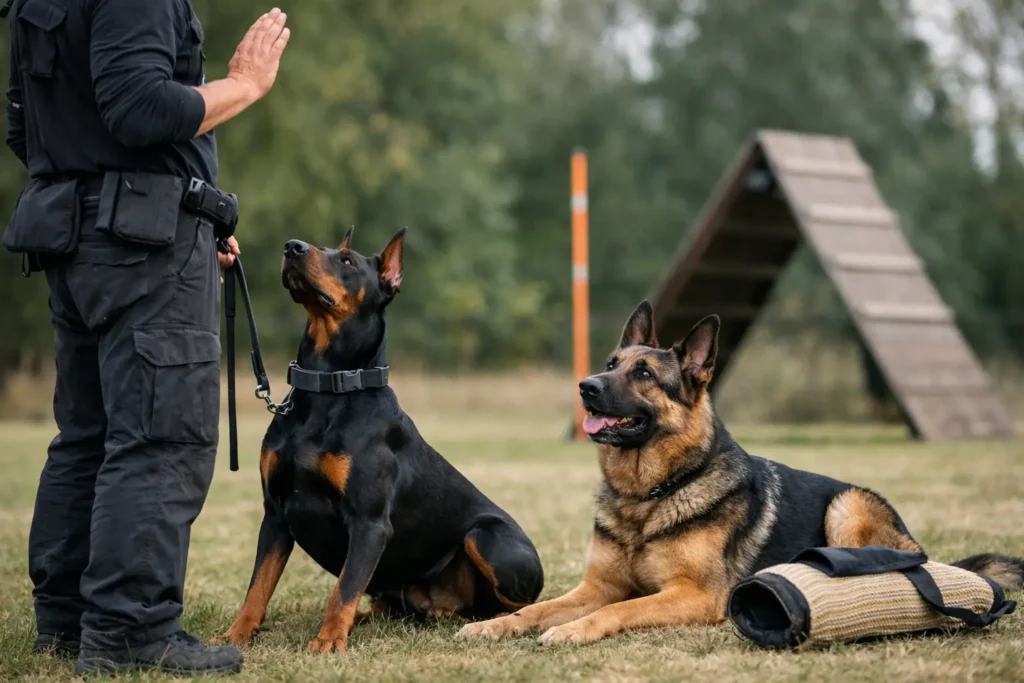
A dog that sits on command in the kitchen is pleasant. A dog that remains composed at the front door, ignores chaos, travels well, responds immediately in public, and can distinguish normal life from a genuine threat is something else entirely. That difference is usually what people mean when they ask what is considered advanced dog training.
For many owners, the phrase gets used loosely. A dog that knows a few extra commands may be called advanced, but true advanced training is not about how many tricks a dog performs. It is about reliability, judgment, control, and the ability to function calmly in real life, not just during a short training session.
What Is Considered Advanced Dog Training in Real Life?
At a basic level, dogs learn sit, down, come, stay, and polite leash manners. That foundation matters, but advanced training begins when obedience holds under pressure. The dog is no longer responding only in quiet, familiar settings. The dog is expected to listen around distractions, in new environments, and during moments that would unsettle an average pet.
In practical terms, what is considered advanced dog training often includes off-leash reliability, extended duration commands, controlled behavior around children and guests, travel confidence, environmental stability, and precise handler responsiveness. For some dogs, advanced work also includes specialized skills such as executive protection, family protection, or highly refined service-related tasks.
The key distinction is this: advanced training is proven in daily life. It is not simply taught. It is maintained, tested, and made dependable.
Advanced Training Is About Reliability, Not Flash
A common misconception is that advanced dogs are the ones that look impressive in videos. In reality, the most valuable advanced training is often quiet. It looks like a dog settling under a table during a business lunch, walking through a crowded hotel lobby without anxiety, staying neutral when visitors arrive, and responding to a command the first time.
This is especially important for families and professionals who want security integrated into normal life. A truly advanced dog should not create tension in the home. The dog should reduce it. That means the training must support everyday companionship just as much as capability.
There is also a difference between a dog that can perform and a dog that can live well. Sport precision, for example, may look impressive, but a household companion needs broader stability. The dog must understand boundaries, recover quickly from stimulation, and remain thoughtful rather than reactive.
The Core Skills That Usually Define Advanced Dog Training
Advanced obedience starts with control at a higher standard. That usually includes longer stays, sharper recalls, heel work with minimal guidance, place commands with real duration, and dependable response at distance. These are not party tricks. They are the tools that make a dog easy to live with and safe to manage.
Environmental neutrality is another major marker. An advanced dog should move through busy streets, elevators, vehicles, new homes, and unfamiliar people without becoming overwhelmed or impulsive. Confidence matters, but so does restraint. An unstable dog can appear bold while still being unsuitable for family life.
Impulse control is equally important. The dog should not rush doors, jump on guests, fixate on distractions, or make independent decisions in moments that require handler direction. In well-trained dogs, composure becomes part of the lifestyle.
Then there is handler awareness. Advanced dogs pay close attention to the person guiding them. They respond not only to known commands, but to tone, timing, and context. That level of responsiveness creates a more natural experience. The dog feels integrated into the household rather than managed minute by minute.
What Is Considered Advanced Dog Training for Protection Work?
This is where the term gets misunderstood most often. Protection training is not automatically advanced simply because a dog can bark, lunge, or bite a sleeve. Those behaviors, without discipline and judgment, are not a mark of quality. They are often a liability.
When asking what is considered advanced dog training in a protection context, the standard should be much higher. The dog must be socially stable, obedient under stress, and capable of clear transitions between affection and defense. The dog should live safely in the home, welcome normal routines, and remain neutral until a situation truly warrants action.
Advanced protection training is less about aggression and more about control. A well-prepared family protection dog understands deterrence, engagement, release, and recovery. Just as important, the dog must be able to turn off immediately. That off switch is one of the clearest signs of quality.
For discerning households, this distinction matters. A dog that makes the family nervous is not a premium protection dog. A dog that blends into family life while providing meaningful deterrence and dependable support is in a very different category.
Advanced Does Not Mean Right for Every Home
It depends on the dog, the household, and the purpose. Some families need exceptional obedience and environmental stability, but no protection training at all. Others want the added reassurance of a dog that can provide controlled deterrence and genuine personal protection if required.
The mistake is assuming that more training is always better in every direction. A high-drive dog with intense training may be impressive on paper but poorly suited for a home with frequent visitors, young children, or owners who travel often. The right advanced training is the training that matches the family’s real life.
That is why thoughtful placement matters as much as training itself. Temperament, social stability, confidence, and ease of living should come before image. The best dogs are not selected because they look intimidating. They are selected because they can carry serious capability without sacrificing companionship.
How to Tell if a Dog Is Truly Advanced
The simplest test is to look beyond the command list. Ask how the dog behaves when life is inconvenient, noisy, or unpredictable. Can the dog hold obedience when guests arrive unannounced? Can the dog settle for long periods indoors? Can the dog travel, adapt, and remain composed in unfamiliar places?
Watch transitions. A polished dog can move from activity to calm without drama. The dog does not need constant correction to behave well. It understands expectations and shows consistency.
You should also ask whether the training has been generalized. Dogs often look excellent in one training field with one handler. That does not always transfer to a home, a neighborhood, a hotel, or a family with children. Advanced training should hold in the environments where the dog will actually live.
For protection-capable dogs, discernment is essential. Look for calm confidence, not frantic intensity. Look for social stability, not suspicion of everyone. Look for immediate obedience before, during, and after pressure. Those qualities are harder to produce, but they are what separate a refined protection companion from a problematic dog.
Why Advanced Training Matters More Than Ever
For many households, the goal is not a dog that performs on command for applause. The goal is peace of mind. That may mean a dog who can accompany the family confidently, create a visible deterrent, and remain deeply affectionate at home. It may mean a dog who offers quiet confidence to an executive, a public-facing professional, or parents who want another layer of security without changing the rhythm of family life.
That is where advanced training becomes valuable. It creates freedom. It allows the dog to be present in more places, trusted in more situations, and woven naturally into the household. Done properly, it gives owners more confidence, not more management.
At High Class K9, that standard is not measured by theatrics. It is measured by how seamlessly a dog can live with the family while providing companionship you feel and security you trust.
The Best Standard for Advanced Training
If a dog is obedient only when conditions are perfect, that is not advanced. If a dog is powerful but difficult to live with, that is not advanced either. The best standard is calm reliability paired with the right level of capability for the home.
A truly advanced dog should feel composed, responsive, and steady. The dog should protect the quality of life inside the home, not interrupt it. When training reaches that level, it stops being a collection of commands and starts becoming something more valuable – confidence you can live with every day.
The right dog does not need to announce its training at every moment. You feel it in the ease of the routine, the steadiness of the temperament, and the quiet assurance that the dog is ready when it matters.