
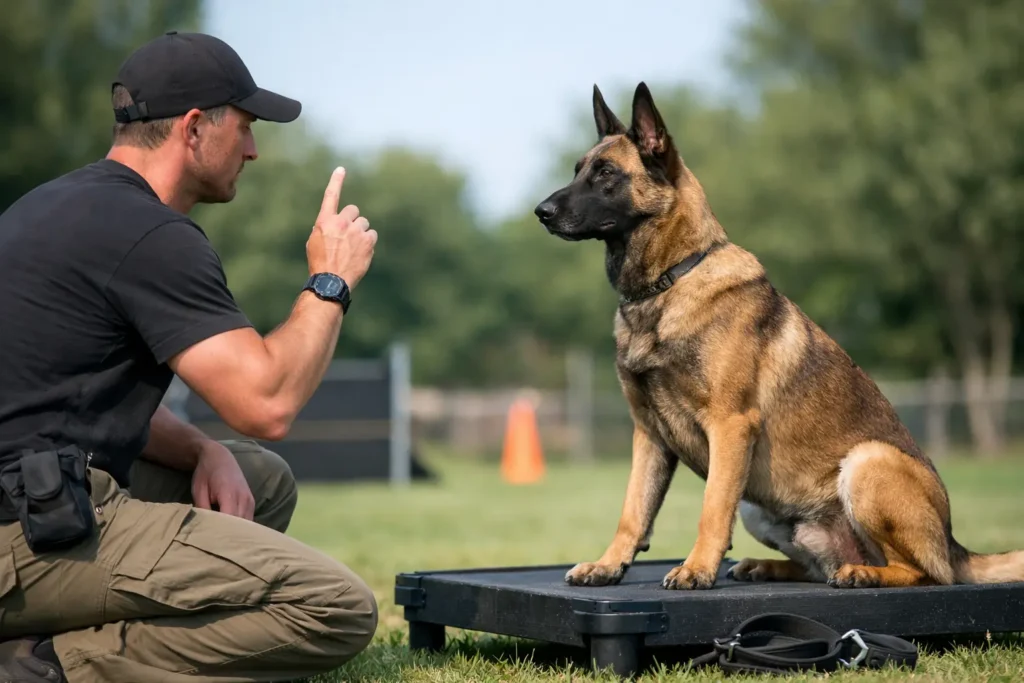
A dog that heels beautifully in a quiet parking lot but unravels when guests arrive, children run through the room, or tension rises at the front door is not truly ready for family life. Advanced obedience training for dogs matters most when the environment is real, the distractions are layered, and the household needs calm, reliable control without turning daily life into a training drill.
For discerning families, obedience is not about showing off precision. It is about trust. It is the difference between a dog that is merely trained and a dog that can live gracefully in a home, travel confidently, and respond under pressure without adding stress to an already sensitive moment. That distinction matters even more when a dog is expected to offer both companionship and credible deterrence.
What advanced obedience training for dogs really means
At the highest level, obedience is not a collection of isolated commands. It is a pattern of behavior that holds together across environments, emotional states, and distractions. Sit, down, heel, place, recall, and duration work are all familiar terms, but advanced work asks a harder question: will the dog comply when the stakes feel different?
That might mean holding position while visitors enter, walking past other dogs without fixation, settling quietly during a family dinner, loading into a vehicle without chaos, or responding instantly when called away from a doorway, a gate, or a rising disturbance. In a protection-minded household, advanced obedience is the control system that makes the dog safe, useful, and easy to live with.
This is where many buyers are misled. A dog can look impressive in short demonstrations and still lack the steadiness needed for refined domestic life. True advanced obedience shows up in the home, in public, around children, near guests, during travel, and in moments that do not follow a script.
Why advanced obedience matters more than intensity
Many people assume a serious dog needs more drive, more edge, or more visible power. In practice, most households need the opposite. They need a dog with enough confidence and clarity to stay composed. The dog should not feel frantic, suspicious of everything, or difficult to manage in ordinary settings.
Advanced obedience creates that composure. It gives the family influence without friction. Instead of constant correction, raised voices, or repeated commands, the dog understands how to move through the day with structure. That leads to a better outcome for everyone in the home.
For families seeking protection capability, this is not a luxury feature. It is the foundation. A dog cannot be considered truly suitable for companion protection if its obedience disappears under social pressure, environmental pressure, or household pressure. Control is what keeps protection work responsible, measured, and compatible with family life.
The difference between trained and placement-ready
Not every well-trained dog is ready for selective family placement. A placement-ready dog has been prepared to fit into real routines with real people. That includes thresholds, household boundaries, neutrality around ordinary distractions, stable behavior in new places, and the ability to settle rather than constantly perform.
This is especially important for executives, families with children, and privacy-conscious households. They are not looking for a kennel dog brought out for a task. They want a companion that can move naturally through the home, join daily life, and still provide confidence when circumstances call for it.
Advanced obedience supports that standard because it creates predictability. The family knows what the dog will do. The dog understands what is expected. That mutual clarity is what allows a premium protection companion to feel elegant in the home rather than disruptive.
How advanced obedience is tested in the real world
The quality of training is rarely revealed by the command itself. It is revealed by context. A dog that responds in low-distraction settings may still struggle when there is motion, noise, social pressure, or uncertainty. Advanced work must account for those variables.
Environmental stability
A refined dog should remain workable across flooring changes, traffic noise, public settings, travel transitions, and unfamiliar spaces. Confidence in new environments is not incidental. It is part of what makes the dog practical for modern family life.
Social neutrality
Not every dog needs to greet everyone, and many should not. But the dog should be stable around invited guests, service personnel, passing strangers, and ordinary public activity. Advanced obedience supports neutrality instead of reactivity.
Household control
One of the clearest signs of quality training is what happens inside the home. Does the dog rush doors, crowd visitors, shadow every movement, or struggle to settle? Or does the dog understand space, boundaries, and calm presence? For most families, household reliability is where value is felt every day.
Response under pressure
This is the standard that separates serious training from surface-level polish. When stimulation rises, obedience should remain intact. The dog should not need escalating conflict from the handler to comply. Reliable response under pressure is built through thoughtful preparation, not theatrics.
Advanced obedience training for dogs and family compatibility
The most desirable dogs are not simply obedient. They are compatible. That means their training supports the way the household actually lives. A family with children may need more emphasis on impulse control and place work. A frequent traveler may value loading, unloading, neutrality in public, and calm hotel behavior. A security-conscious homeowner may prioritize threshold control, recall, and stable response at entry points.
This is why a generic training package rarely tells the full story. Advanced obedience should reflect the realities of the household, not just a trainer’s preferred exercises. It should feel tailored, because the demands of a quiet suburban home are different from those of an executive household with frequent visitors, staff, travel, and a more public profile.
For that reason, thoughtful placement matters as much as training itself. The right dog for one family may not be the right dog for another, even if both dogs are highly capable.
What discerning buyers should look for
A polished sales demonstration can be convincing, but serious buyers should look deeper. The right questions are not just about what commands the dog knows. They are about how the dog lives.
Ask whether the dog can remain composed around normal domestic activity, whether the training has been proofed in varied environments, and whether the dog’s temperament supports affectionate companionship as naturally as control. Ask how the dog transitions into a new home and what guidance is provided after placement.
Those details matter because advanced obedience is not frozen at the moment of sale. It must transfer to the family. A responsible provider understands that long-term success depends on stewardship, education, and honest matching. A premium dog deserves a premium transition.
At High Class K9, this is why placement is approached with selectivity rather than volume. The goal is not simply to present a trained dog. It is to place the right dog into the right household with the kind of support that protects both performance and harmony at home.
The trade-off buyers should understand
There is a difference between a dog trained for spectacle and a dog trained for life. Spectacle can look sharper in short clips. Life requires steadiness, restraint, and clarity. For many households, that quieter excellence is more valuable than dramatic intensity.
It also means expectations should be realistic. Even exceptional dogs need consistency after placement. They need handlers who respect the training, maintain standards, and understand that obedience is part of a relationship, not a remote-control function. The best outcomes happen when training quality and owner guidance meet in the middle.
That is one reason founder-led involvement and continued support matter so much. A family making a premium protection dog investment is not just buying training hours. They are placing trust in judgment, selection, and long-term accountability.
Why advanced obedience is the standard, not the extra
For the right dog, advanced obedience does more than improve behavior. It protects the feel of the home. It allows security to exist without tension. It preserves the dog’s ability to be affectionate, stable, and welcome in the spaces that matter most.
That is the real value. Not a louder dog, but a clearer one. Not a dog that dominates the household, but one that moves through it with presence, control, and quiet confidence. When training reaches that level, the result is not just obedience. It is peace of mind you can actually live with.
If you are evaluating a dog for family companionship, deterrence, or personal security, look past the demonstration and consider the daily experience. The best-trained dog is the one that makes your life feel safer, calmer, and more settled from the moment it comes home.