
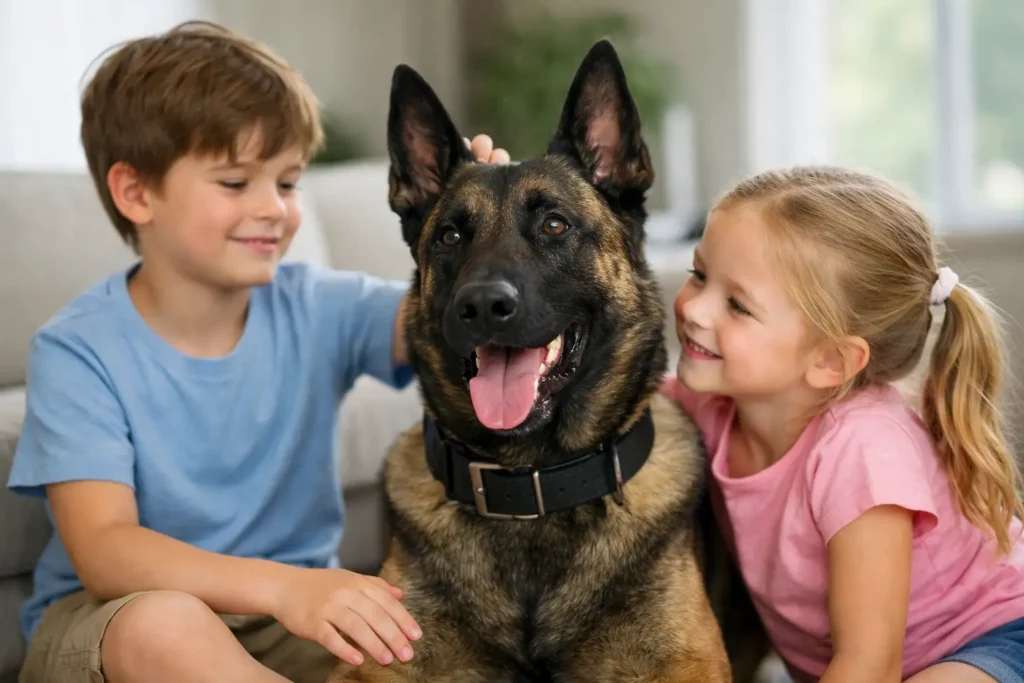
A family can feel this question the moment they picture a protection dog beside a child at breakfast, in the carpool line, or curled up in the den after school. Are protection dogs safe with children? The honest answer is yes, but only when the dog has the right temperament, the right training, and the right placement for that specific household. The wrong dog can create stress. The right dog becomes a calm, affectionate presence that adds confidence to daily life rather than disrupting it.
That distinction matters more than many buyers realize. A true family protection dog should not live like a specialized working asset that the household tiptoes around. It should live comfortably in the home, move through normal routines with stability, and understand the difference between ordinary family activity and a genuine threat. For families with children, that standard is not optional.
Are protection dogs safe with children in real family life?
They can be, but safety comes from selectivity, not labels. Calling a dog a protection dog does not make it suitable for a household with children. In fact, some dogs marketed for protection are simply too intense, too environmentally sharp, or too reactive for family life. A child runs, squeals, drops food, invites friends over, and creates exactly the kind of busy, unpredictable environment that exposes instability fast.
A properly selected family protection dog is different. It is composed in the home, affectionate without being needy, obedient without constant pressure, and naturally clear-headed around movement, noise, and changing social situations. That kind of dog does not see normal childhood behavior as a problem to correct. It reads the room well, settles easily, and responds to direction.
The protection component should also be controlled and situational. A serious dog should not be operating on constant suspicion. It should deter when necessary, respond when appropriate, and otherwise behave like a polished household companion. Families are not looking for tension in the home. They are looking for peace of mind.
What actually makes a protection dog safe around kids
The first factor is temperament. Training matters, but temperament sets the ceiling. A dog that is nervy, unstable, overly suspicious, or environmentally weak is not made safe by advanced obedience alone. For children, the ideal dog is confident, social in the right way, and steady under pressure.
The second factor is lifestyle compatibility. A family with young children has a different rhythm than a single executive or a retired couple. There may be toys on the floor, frequent guests, after-school activity, and spontaneous movement. A dog placed into that environment must be able to live comfortably inside that rhythm. Good placement is not about finding an impressive dog. It is about finding the right dog for the people who will live with it.
The third factor is clarity in training. A well-trained protection dog understands everyday household rules with precision. It knows how to settle, how to travel, how to respond to direction, and how to remain neutral when nothing is wrong. Protection should never feel like chaos waiting to happen. It should feel disciplined, predictable, and discreet.
Finally, there is owner guidance. Even a well-prepared dog benefits from a family that understands boundaries, routines, and how to maintain consistency. That is one reason thoughtful stewardship matters so much after placement. Long-term success rarely comes from simply handing over a dog and hoping the family figures it out.
Not all children create the same environment
Age matters. So does maturity. A household with a calm thirteen-year-old is very different from one with a curious toddler and a busy first grader. That does not mean younger children automatically rule out a protection dog, but it does mean the margin for error is smaller.
With very young children, supervision is essential because young kids often do things adults would never do. They may hug too tightly, climb into the dog’s space, or mistake tolerance for invitation. A quality family protection dog should be patient and stable, but no dog should be expected to function as a piece of furniture. Respectful structure protects both child and dog.
Older children usually make integration easier because they can follow rules, read basic signals, and participate in routine. They can learn not to interrupt the dog while it is resting, not to encourage rough play, and not to test boundaries for amusement. Those small habits shape a safer household.
The biggest misconception about family protection dogs
Many people assume the risk comes from protection training itself. More often, the real risk comes from poor matching and poor standards. A dog can be highly trained and still be a poor fit for children if it lacks emotional stability. On the other hand, a dog with balanced temperament and disciplined training can live beautifully in a family setting.
The goal is not a dog that is aggressive. The goal is a dog that is discerning. That difference is everything. Families who want genuine protection usually do not want a dog that reacts to every delivery driver, every soccer friend, or every burst of household energy. They want a dog that can live with warmth and respond with seriousness only when the situation truly calls for it.
That is why families should be cautious around flashy demonstrations and bold marketing claims. Controlled clips and dramatic language can make almost any dog look impressive. What matters more is how that dog behaves in the quiet moments of daily life. Can it lie calmly while children move around the room? Can it travel well? Can it remain composed when guests arrive? Can it shift from companionship to deterrence without confusion? Those are the questions that reveal whether a dog belongs in a family environment.
Are protection dogs safe with children if friends and visitors come over?
They can be, provided the dog has been prepared for real household life and the family follows sensible structure. Children’s homes are social environments. Friends visit. Relatives stop by. Service providers appear at the door. Good family protection dogs are trained to distinguish normal access from concerning behavior, and they take direction well from their handlers.
That does not mean families should operate casually. Introductions should be managed, expectations should be consistent, and children should not treat the dog as a novelty during playdates. The safest homes are the ones where the adults lead and the dog does not have to guess what is expected.
A composed protection dog can actually be a stabilizing presence in a busy home. Its confidence often translates into a quiet kind of order. But that result depends on selection, preparation, and mature ownership. It is not something to assume merely because a seller says the dog is family safe.
What discerning families should look for
Start with the company’s placement philosophy. If the process feels rushed, generic, or volume-driven, that is a concern. Families with children need more than a trained dog. They need a thoughtful match based on household dynamics, travel patterns, privacy needs, and the day-to-day texture of life in the home.
Ask how the dog lives, not just how it performs. A polished protection dog should be easy to live with. It should show affection naturally, recover quickly from stimulation, and integrate into domestic life without constant management. It should feel like a trusted companion first, with protection capability present when needed.
It is also reasonable to ask what happens after placement. Families change. Children grow. Routines shift. Ongoing support matters because success is not measured on delivery day. It is measured months and years later, when the dog is still fitting the family well and the family still feels confident.
For that reason, many high-trust buyers prefer founder-led guidance and selective placement rather than a transactional sale. With a company like High Class K9, the standard is not simply whether a dog can protect. The standard is whether the dog can protect while living beautifully inside the family.
The right answer is specific to the household
So, are protection dogs safe with children? Yes, when the dog is stable, properly trained, and carefully matched to the family. No, not every protection dog is appropriate for a home with children, and that is exactly why selectivity matters.
Families should not have to choose between security and a warm, natural home life. The right protection dog supports both. It brings deterrence without disorder, companionship without compromise, and confidence that extends into the places that matter most – the front door, the family room, and the ordinary moments that should still feel easy.
If you are asking this question, you are already thinking the right way. Not about image, but about fit. And that is where good decisions begin.