

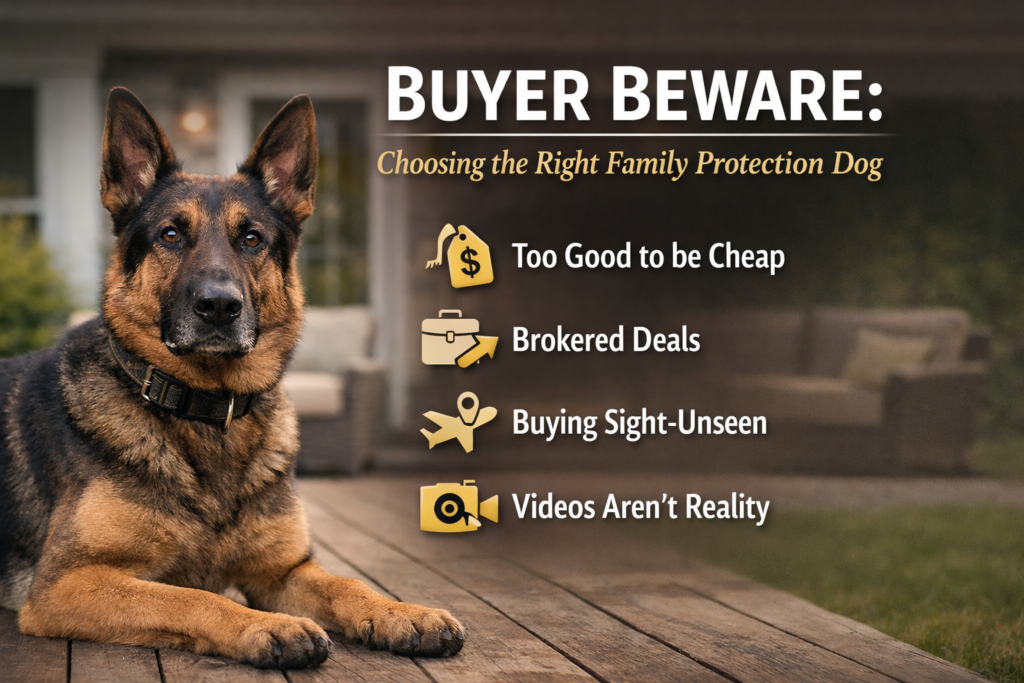
The trained protection dog industry remains largely unregulated, which creates meaningful risk for families. Many reputable providers exist, but there are also operations with polished marketing that do not consistently deliver stable, family-suitable dogs.
The “Low-Cost” Protection Dog Risk
Breeding, raising, selecting, importing, training, and supporting dogs suitable for family protection requires significant time and resources. When pricing appears unrealistically low, corners are often cut—most commonly in socialization, stability, and proper development.
A family protection dog must be safe around children and normal household activity. Dogs developed through fear, confinement, or provocation may look intense on video, but can be unsuitable in real family environments.
The Broker / “Waiting List” Model
Be cautious of providers who primarily operate as brokers—placing clients on a “waiting list” and then sourcing a dog they have not personally raised, evaluated, or lived with.
When the provider does not have direct, hands-on knowledge of the dog, it becomes difficult to match temperament, stability, and lifestyle fit—especially for family placements.
Buying Direct From Europe
European bloodlines can be exceptional, but purchasing a dog overseas without in-person evaluation creates risk. There is limited legal recourse, the existence of fraudulent sellers, and the challenge of verifying health and temperament remotely.
A responsible approach is to work with a reputable program that can verify temperament, living conditions, and suitability before any placement is considered.
Marketing Does Not Equal Suitability
High-quality videos can be valuable, but they do not prove temperament stability or long-term suitability for your household. A trained protection dog should be evaluated for real-world behavior, recovery under stress, and family compatibility—not just performance clips.
What Responsible Families Should Ask
Before committing to any trained family protection dog, ask:
Who owns the dog today, and who has owned the dog throughout training?
Can I speak with real client references (not just testimonials)?
What written commitments exist regarding health and suitability?
How was the dog raised, socialized, and developed day-to-day?
What ongoing support is included after placement?
A Note on Selectivity
Not every dog qualifies for family protection placement. Not every household requires a protection-trained dog. The safest outcomes occur when selection and matching come first, and training follows a stable temperament foundation.
If you’d like guidance on whether a professionally trained family protection dog is appropriate for your household, you may submit a confidential request for consideration.