
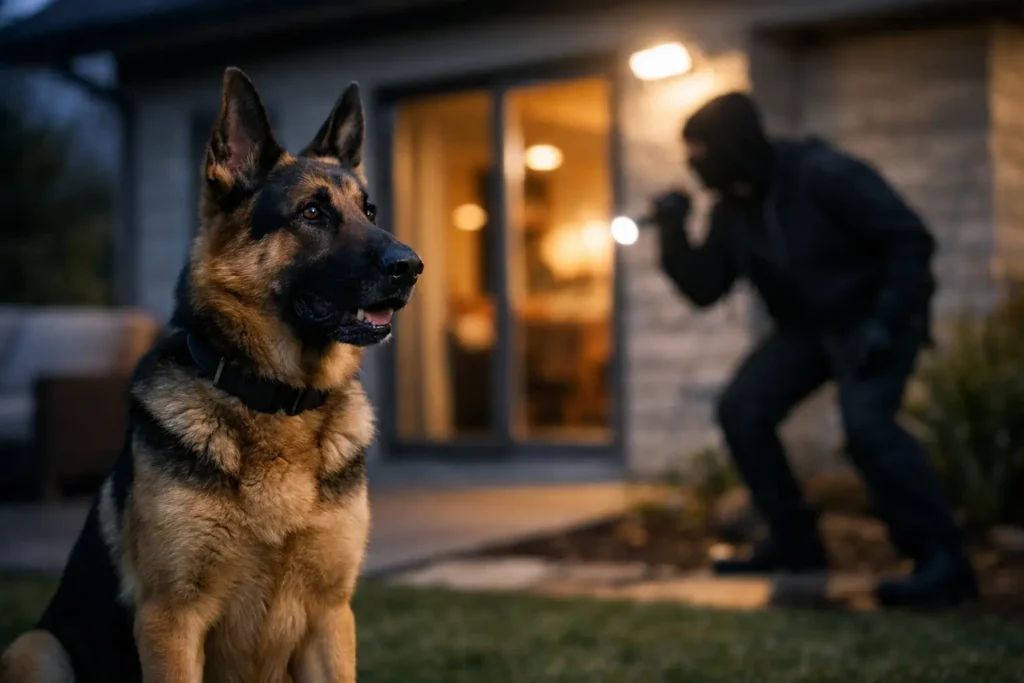
A home can look quiet from the street and still feel exposed to the people inside it. For families, executives, and public-facing professionals, the value of a protection dog is often understood before any confrontation occurs. How protection dogs deter intruders is less about aggression than perception: a capable, stable dog changes the risk calculation for anyone considering the wrong approach.
A properly selected family protection dog brings a visible, living layer of security into daily life. It is present when the family returns late, when a spouse is traveling, when children are playing in the yard, and when an unexpected person approaches the home. The goal is not disruption. It is confidence, delivered by a companion that belongs naturally in the household.
How Protection Dogs Deter Intruders Before Entry
Most intruders are looking for opportunity, not difficulty. They prefer a property that appears unoccupied, unaware, or easy to enter and leave. A dog with a substantial, composed presence immediately introduces uncertainty. Is the dog merely alert? Is it trained? Is someone inside who has been notified? Can the person get close without being challenged?
That uncertainty matters. A protection dog does not need to create chaos to be effective. Its awareness, posture, and willingness to acknowledge unfamiliar activity can make a property far less attractive than the next available option. In many cases, that is the outcome a family wants: an unwelcome person decides not to proceed.
The strongest deterrent is credible, not theatrical. A dog that is calm around normal household movement but clearly attentive to an unfamiliar presence sends a more meaningful message than one that barks indiscriminately at every passerby. Constant noise becomes background sound. Controlled awareness remains noticeable.
Presence Is Different From Intimidation
An exceptional family protection dog should not make its own home feel tense. The dog should be affectionate with its people, reliable around expected guests, and able to settle quietly during ordinary life. At the same time, it should have the confidence to recognize when a situation deserves attention.
This distinction is essential for discerning households. A dog that reacts to every delivery, neighbor, or visitor may look protective, but it can reduce comfort and create unnecessary stress. A stable dog is selective. It can be relaxed beside the family at dinner, travel comfortably, and still make an intruder reconsider crossing a boundary.
The Deterrent Begins at the Property Line
Protection is not limited to the front door. A dog may notice changes in the environment long before a person inside does: movement near a gate, an unfamiliar vehicle slowing outside, or someone lingering where they do not belong. Their hearing and scent awareness add another dimension to household security, particularly at night or on larger properties where visibility is limited.
An alert response gives the family time to assess what is happening. Sometimes that means looking outside, contacting security, or simply ensuring doors are secured. The point is not to place every decision on the dog. It is to provide an early, dependable signal that something has changed.
For intruders, that signal can be enough. A home with an attentive dog is difficult to approach unnoticed. Even when a person does not see the dog immediately, evidence of its presence can influence behavior. A confident bark from inside the home or a controlled display of alertness at a window communicates that the property is occupied and aware.
Why Stable Temperament Creates Real Security
The word “protection” can lead people to focus only on physical capability. In a family setting, temperament is just as significant. An unpredictable dog is not a refined security solution. It can create risk around children, visitors, household staff, and the very people it is meant to protect.
A well-matched protection dog has the discernment to live peacefully in a busy home while responding appropriately to genuine concern. This balance supports the deterrent effect because confidence is visible. The dog is not fearful, frantic, or overstimulated. It is settled, observant, and secure in its relationship with the family.
That is why placement should never be based on appearance alone. A large or imposing dog may discourage some unwanted attention, but size does not guarantee judgment, trainability, or suitability for a particular household. The right match depends on the family’s lifestyle, children, travel habits, property, experience with dogs, and security concerns.
Controlled Training Makes the Difference
A protection dog’s value is not measured by how often it reacts. It is measured by its ability to listen, settle, and respond under control. Advanced obedience is central to this standard. A dog that can be directed reliably around the home and in public is better equipped to support the family without becoming a liability.
Controlled deterrence also protects everyday life. The dog should understand boundaries, respond to its handler, and distinguish between ordinary social activity and behavior that warrants greater attention. This allows families to host friends, welcome service providers with appropriate supervision, and move through the world with more ease.
Training is not static, either. A dog may arrive prepared, but a successful placement includes educating the household on communication, routines, and responsible handling. Consistency helps preserve the dog’s clarity and confidence. Long-term guidance is particularly valuable as a family’s schedule, home environment, or security needs change.
The Human Element Still Matters
A protection dog is an exceptional complement to thoughtful security practices, not a substitute for them. Secure doors, lighting, cameras, alarm systems, and clear household routines each play a role. The dog adds something those tools cannot fully replicate: a responsive companion that is physically present and attuned to the family’s environment.
It also requires responsible ownership. Families should establish sensible visitor procedures, maintain the dog’s obedience, and avoid asking it to make decisions it has not been trained to make. Children should be taught respectful interactions, and adults should remain attentive when unfamiliar people enter the property.
The most effective homes use layers. A visible camera may make someone pause. Good lighting may remove concealment. A dog’s alert presence can turn hesitation into a decision to leave. Together, these measures create a property that feels watched, prepared, and far less inviting to an intruder.
Choosing a Dog That Fits the Life You Actually Live
The best protection dog is not necessarily the most intense dog. It is the dog that can succeed in the life you have. A family with young children needs a different temperament and management plan than an executive who travels frequently or a homeowner with regular staff and visitors. A city residence presents different considerations than a large private estate.
Thoughtful placement looks beyond the dog’s working ability. It considers affection, confidence, composure, social stability, health, and the ability to transition comfortably between home, vehicle, travel, and public settings. At High-Class K9, this level of compatibility is treated as part of security itself, because a dog that fits the household is a dog the family can confidently include in everyday life.
There are trade-offs to consider. A more visibly imposing dog may be a stronger visual deterrent, while a more understated companion may better suit frequent travel or a highly social home. Some families want a dog that is naturally more watchful; others value a quieter presence with clear obedience. Neither preference is universally right. The standard should be a stable dog whose capabilities align with the family’s needs and responsible handling.
Peace of Mind Has a Daily Shape
The benefit of a family protection dog often appears in small moments: walking from the car to the front door after dark, hearing an unexpected sound outside, or knowing a loved one is not alone when you are away. These are not dramatic scenes. They are the ordinary situations where peace of mind has real value.
A properly placed dog offers companionship you can feel and security you can trust. When the fit is right, the dog does not take over the household. It becomes part of the reason the household feels more settled, more aware, and more secure.