
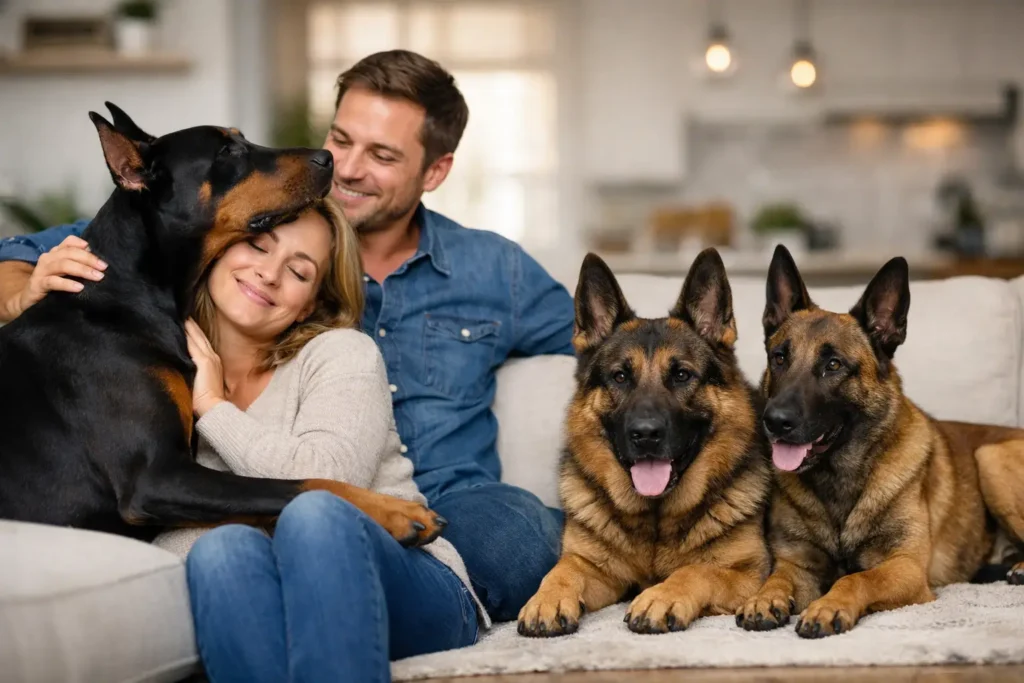
A dog can settle beside your chair during a quiet dinner, greet the children with genuine enthusiasm, and still carry the training and composure to provide meaningful deterrence when needed. So, are protection dogs affectionate? The right professionally developed dog can be deeply affectionate, but that affection is not accidental. It comes from stable temperament, thoughtful selection, and the relationship built after the dog enters your home.
For many families, this is the question beneath every other question. They are not looking for a dog that simply appears impressive during a demonstration. They want a companion that belongs in the rhythm of family life: calm in the house, pleasant to travel with, engaged with its people, and steady when the environment changes. Protection capability matters, but it should not come at the cost of a warm, livable relationship.
Are Protection Dogs Affectionate, or Just Trained?
Affection and protection work are not opposites. In fact, a dog that lives closely with its family needs the emotional stability to enjoy ordinary life. A dog may show that connection by following its owner from room to room, resting nearby, seeking calm physical contact, or brightening at the prospect of time together. Some are openly demonstrative. Others are more reserved but strongly bonded, showing affection through attentiveness and a preference for being near their people.
Training can shape behavior, but it does not manufacture a suitable underlying temperament. A dog can be taught advanced obedience and controlled responses, yet still lack the social stability or household compatibility a family needs. That is why selection matters as much as development. The most suitable family protection dog is not chosen merely for intensity or appearance. It must have the clarity to distinguish normal daily life from a situation that requires its attention.
The word affectionate also deserves some perspective. It should not mean a dog welcomes unlimited handling from everyone, ignores boundaries, or behaves the same way with every visitor. A mature, well-balanced dog may be devoted to its family while remaining neutral or appropriately reserved with unfamiliar people. That is often a far more desirable quality than indiscriminate friendliness.
What Affection Looks Like in Everyday Family Life
In a successful placement, affection is usually visible in the unremarkable moments. The dog settles after the morning routine rather than pacing for stimulation. It enjoys joining the family in a common area without demanding constant attention. It responds willingly when called, relaxes in familiar spaces, and looks to its owners for direction when something unfamiliar occurs.
This kind of companionship has a quieter quality than many prospective owners expect. A stable dog does not need to create a scene to show devotion. It may lie at your feet while you work, remain close during an evening walk, or choose to rest near the bedroom door. These are not simply trained positions. Over time, they often reflect trust, routine, and the dog’s sense that it belongs with its family.
For households with children, the goal is not to assume affection will solve every interaction. Children and dogs need clear boundaries, and adults remain responsible for supervision and management. A dog should have a place to rest without being disturbed, while children should learn how to approach, touch, and give space respectfully. When the household is predictable, the dog is more likely to be relaxed and reliable within it.
Why Protection Capability Does Not Require a Harsh Dog
There is a persistent misconception that a dog capable of protection must be distant, hard to live with, or constantly alert to threats. In reality, a dog that treats every sound, visitor, or unfamiliar setting as a crisis is not providing the kind of confidence most families want. It is adding strain to daily life.
Controlled protection depends on clarity. The dog needs to understand when to be neutral, when to follow direction, and when its presence alone is enough to create space. A composed dog can move through a hotel lobby, receive clear guidance around household guests, and settle at home without losing awareness of its environment. That balance is valuable because it allows the dog to be a companion first in most moments.
This does not mean any affectionate dog is suited for a protection role. A pleasant personality alone is not enough. The dog also needs confidence, sound nerves, willingness to work with its handler, and the ability to recover calmly from normal surprises. Those qualities must be evaluated carefully before a dog is considered for a family protection environment.
The Home Relationship Determines Much of the Outcome
A professionally developed dog arrives with an exceptional foundation, not a finished relationship. The real bond begins at home, where the dog learns your routines, your expectations, and the people who matter most to it. Every ordinary interaction teaches something.
Owners who build the strongest relationships tend to be clear and consistent. They create predictable routines around meals, rest, walks, visitors, and time together. They give the dog meaningful engagement rather than assuming affection alone will create a bond. They also maintain the standards the dog has learned, using fair guidance instead of allowing rules to change according to the day or the family member.
This matters because dogs learn from the whole household. If one person invites the dog onto furniture while another corrects it for doing so, the dog receives mixed information. If guests are sometimes encouraged to overwhelm the dog with attention and other times asked to keep distance, the dog has no stable picture of what is expected. Consistency is not harshness. It is one of the clearest ways to help a dog feel secure.
Affection should be part of that structure, not separate from it. Enjoy the dog. Include it in family life. Give it calm attention, play, exercise, and chances to work with you. At the same time, respect its need for rest and maintain boundaries that make interactions understandable. A dog that knows what to expect is more able to relax and connect.
Questions Worth Asking Before Placement
The best question is not simply, “Will this dog love my family?” A more useful conversation examines how your family actually lives. Frequent travel, young children, other pets, staff, regular guests, a second residence, and an active social calendar all influence what kind of dog may fit well.
Ask how a prospective dog behaves in a home setting, how it responds to calm social contact, and what type of owner guidance it will need after placement. Discuss whether the dog is naturally more demonstrative or more reserved, and what that looks like in practical terms. A reserved dog is not necessarily less bonded. It may simply express attachment through loyalty and proximity rather than exuberant greeting behavior.
It is also wise to ask what ongoing support looks like. Even an experienced dog owner benefits from guidance during the transition period. New surroundings, unfamiliar routines, and different household dynamics require adjustment. Thoughtful placement recognizes that matching the dog to the home is only the beginning of long-term success.
At High-Class K9, the standard is not to treat protection and companionship as competing features. A meaningful placement considers both: the dog’s ability to live naturally with the family and its capacity to provide composed, handler-directed protection when circumstances call for it.
A Bond That Grows Beyond the First Week
The first days with a new dog can be quieter than people anticipate. Some dogs are immediately social; others take time to understand their new environment and form trust. Neither response automatically predicts the quality of the eventual relationship. Patience, routine, and calm leadership give the dog room to settle without pressure.
Over the following weeks and months, small moments carry weight. The walk where the dog begins checking in naturally. The evening it settles easily among the family. The way it responds to your voice in a new place. Trust is rarely created by one grand gesture. It develops through repeated experiences in which the dog learns that its home is orderly, its people are fair, and its role is understood.
The most rewarding family protection dogs do more than bring a sense of security to the property. They become familiar, steady presences in the life of the household. Given the right dog, the right fit, and responsible ownership, affection is not a compromise. It is part of what makes the relationship worth having.