
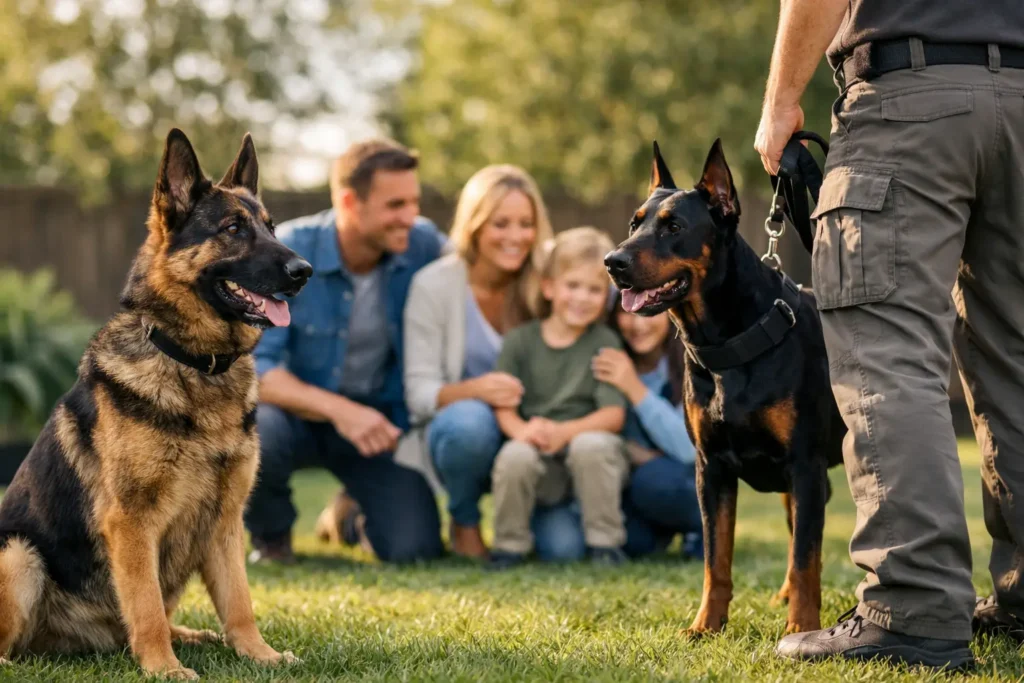
A protection dog should not change the feeling of home. The right dog moves comfortably through a family’s routines, settles beside the children, travels with confidence, welcomes life’s ordinary moments, and provides a calm, credible layer of security when it matters. This personal protection dog selection guide is designed for households that expect both meaningful companionship and dependable peace of mind.
The distinction matters. A dog may look impressive, respond sharply in a demonstration, or carry an imposing presence, yet still be poorly suited to a busy household. True family protection is not defined by intensity. It is defined by stability, discernment, obedience, and the ability to live beautifully within the family it is entrusted to protect.
Start With Your Life, Not a Breed
The strongest placements begin with an honest view of daily life. Consider who lives in the home, how often you entertain, whether children or grandchildren visit, how frequently you travel, and what level of activity feels natural for your household. A dog’s security capability is only valuable when the dog can be included consistently in the life it is meant to protect.
A family with young children may need an especially patient, socially stable companion with excellent manners around movement, noise, and changing routines. An executive who travels between residences may prioritize calm transport behavior, discretion in public, and confidence in unfamiliar environments. A homeowner who entertains regularly may need a dog that can distinguish normal guests from genuine concern without becoming unsettled by everyday activity.
There is no single “best” protection dog for every client. The best dog is the one whose temperament, energy, social comfort, and training align with the way your household actually lives. A thoughtful advisor should ask more questions about your family than about the dog’s appearance.
What to Look for in a Family Protection Dog
A properly selected personal protection dog should feel composed, not volatile. The dog should be affectionate with its family, clear-headed in new settings, responsive under distraction, and able to settle when nothing requires its attention. Presence alone can be a meaningful deterrent, but calm judgment is what makes that presence suitable for private life.
Stability Is the Foundation
Look for emotional steadiness above all else. A stable dog is not startled into poor decisions by a dropped object, an unfamiliar visitor, a busy airport, or the normal unpredictability of family life. That does not mean the dog is passive. It means the dog has the confidence to assess a situation rather than react impulsively.
This quality is particularly important for households with children, staff, frequent visitors, or multiple residences. The dog should be able to move from a quiet morning at home to a more active environment without carrying unnecessary tension into every interaction.
Obedience Should Make Daily Life Easier
Advanced obedience is not a performance for guests. It is the practical language that allows a dog to live with freedom and structure. A well-trained dog should respond reliably to its family, remain manageable around distractions, and understand how to settle on command when the household needs calm.
Ask how the dog behaves during ordinary moments: entering the home, greeting approved visitors, walking through public spaces, riding in a vehicle, resting during a meal, or remaining composed while children play. These are the situations that determine whether a dog adds confidence to daily life or becomes another source of management.
Protection Must Be Controlled and Situational
The purpose of a personal protection dog is not to create drama. It is to provide a serious, visible security presence with the judgment and control to respond appropriately if a real threat develops. A dog that is indiscriminately suspicious, difficult to redirect, or easily overstimulated is not a refined protection solution.
Seek dogs trained to work within clear boundaries and to remain responsive to their handlers. The goal is confidence without chaos: a companion that is relaxed when life is normal and prepared when circumstances are not.
A Personal Protection Dog Selection Guide for the Home
When evaluating a dog, it helps to picture a full week rather than a brief meeting. Can the dog relax in the family room? Is it comfortable around children’s routines? Does it travel quietly? Can it accompany you to a second home, a private office, or a social setting with appropriate manners? Will the dog be content with the exercise and engagement your household can realistically provide?
A sophisticated placement process considers these questions before recommending a match. Size, color, and breed preference may matter, but they should not outweigh temperament and compatibility. A larger dog may offer a more substantial visual deterrent, for example, while a more compact dog may better suit frequent travel or urban living. Neither choice is automatically superior. The right decision depends on your environment and priorities.
It is also wise to consider the dog’s relationship with the people closest to you. A premium family protection dog should form a genuine bond with its household, not simply obey commands. Affection, trust, and consistency create the relationship from which dependable protection grows.
Questions Worth Asking Before You Commit
The quality of the provider matters as much as the quality of the dog. A serious placement partner should be transparent about the dog’s health, temperament, training, and suitability for your particular home. They should welcome detailed conversations about your lifestyle rather than pushing a quick selection.
Ask how the dog has been evaluated around normal household variables, including visitors, vehicles, unfamiliar settings, and distractions. Ask what transition support is provided after placement, how the provider handles questions once the dog is home, and whether clear health and satisfaction protections are available in writing.
You should also ask who will guide the selection process. Direct, experienced involvement creates accountability. High-Class K9 approaches placement as a long-term responsibility, because the right outcome is not simply a successful delivery. It is a dog that becomes a trusted, beloved part of the family for years to come.
Be cautious of decisions based solely on a short video, a dramatic display, or a promise that any dog can fit any home. Protection capability is only one part of the equation. A dog can be highly skilled and still be wrong for a household’s pace, social environment, or expectations. Selectivity is not a limitation. It is how responsible placement protects the family and the dog.
Prepare the Household for a Strong Transition
Even an exceptionally trained dog benefits from a clear, consistent introduction to its new home. Before arrival, decide where the dog will rest, who will handle primary routines, and how visitors will be introduced. Simple household consistency helps the dog understand its place quickly and allows its training to transfer naturally into family life.
Every member of the household should understand the dog’s boundaries and the basic commands that support calm control. Children should be taught to respect resting spaces and engage with the dog appropriately. The aim is not to make the home rigid. It is to give the dog clarity, which creates greater ease for everyone.
Ongoing stewardship also matters. A protection dog’s relationship with its family deepens through daily consistency, appropriate activity, and continued guidance. A provider who remains available after placement offers more than convenience. They provide reassurance during the moments when questions arise, routines change, or the family simply wants to ensure it is doing right by the dog.
The right protection dog will never feel like a security device placed inside your home. It will feel like a devoted companion whose calm presence lets your family enjoy life with greater confidence, freedom, and peace of mind.