
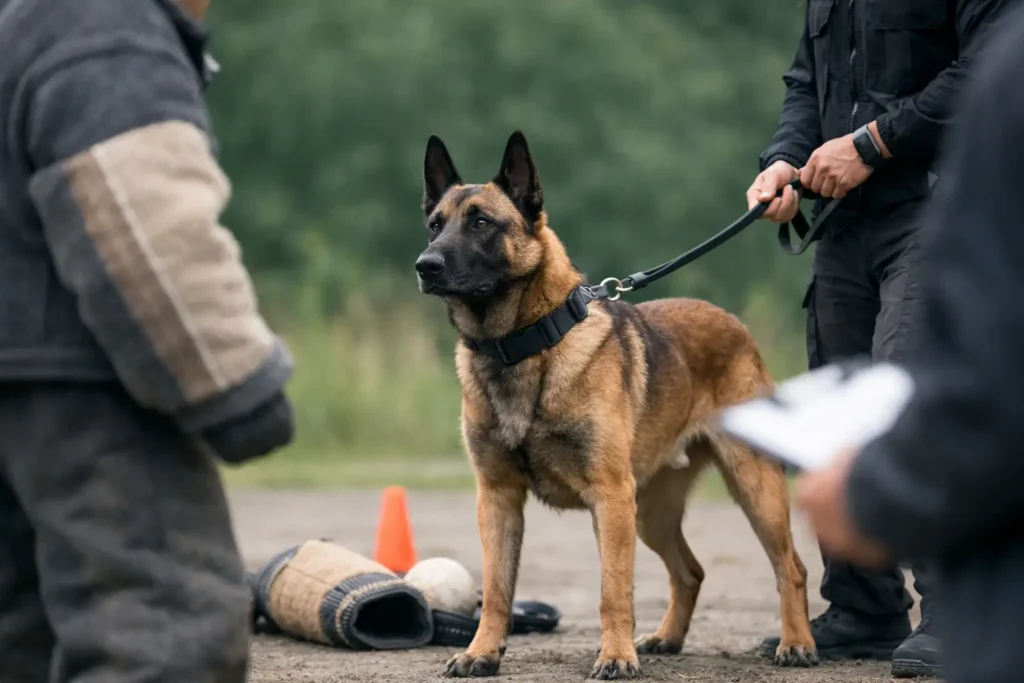
A polished protection dog can look impressive in a training field and still be the wrong fit for a home. That is why a protection dog temperament test matters so much. For families, executives, and private clients, the real question is not whether a dog can respond to pressure. It is whether that dog can live well in the home, remain clear-headed around everyday life, and offer confidence without creating tension.
This is where many buyers make a costly mistake. They focus on visible performance and overlook temperament. The bark, the obedience routine, the controlled scenario – those are only part of the picture. The deeper issue is how the dog processes stress, how naturally it settles, and whether it can shift from companion to deterrent without becoming unstable or difficult to live with.
What a protection dog temperament test is really measuring
A true protection dog temperament test is not a theatrical exercise designed to impress a buyer. It is a careful evaluation of character. The goal is to understand how a dog thinks, recovers, engages with people, and functions under pressure.
That distinction matters. Protection in a family setting requires far more than courage. The dog must be socially stable, environmentally sound, and emotionally balanced. It should not be suspicious of normal guests, frantic in busy environments, or overly reactive to harmless surprises. A dog that lives close to children, visitors, household staff, travel routines, and public settings needs a temperament that remains predictable.
The best protection dogs tend to share a specific kind of balance. They are confident without being restless, observant without being nervy, and affectionate without becoming soft or insecure. They can read context. They understand when life is normal and when something is wrong. That ability is far more valuable than exaggerated intensity.
The traits that matter most in a protection dog temperament test
Confidence sits near the top of the list. A suitable dog does not fall apart in new spaces, on slick floors, around noise, or in unfamiliar routines. That does not mean the dog never notices change. It means the dog recovers quickly and keeps thinking.
Nerve strength is closely related, but it deserves its own attention. A dog with strong nerves can handle stress without becoming erratic. In practical terms, this shows up as steadiness around pressure, measured reactions, and the ability to settle after stimulation. Families do not need a dog that stays on edge. They need one that can switch off.
Social stability is equally important. A well-bred, well-selected protection dog should not carry unnecessary civil aggression into ordinary life. It should be neutral or pleasant with appropriate people, comfortable in the home, and able to live with structure. This is one of the clearest signs of quality. The dog protects when needed, not because it is perpetually looking for conflict.
Trainability also matters, although it is often misunderstood. Buyers sometimes assume trainability means flashy obedience. In reality, it means the dog accepts guidance, remains clear under correction, and wants to work with its handler. That quality supports long-term success because protection is only one part of the dog’s role. Day-to-day ease is what makes ownership enjoyable.
Then there is recovery. This is one of the most revealing parts of any evaluation. Startle a dog, challenge the dog, interrupt the dog – then watch what happens next. A suitable dog regains composure. A questionable dog may stay unsettled, avoidant, or overly aroused. Recovery tells you how the dog will function in real life, where surprises are unavoidable.
Why the wrong temperament can look impressive at first
Some dogs initially appeal to buyers because they present as intense, highly alert, or very sharp. To the untrained eye, that can read as powerful protection ability. In reality, those same traits can create strain inside the home.
A dog that is too reactive may be difficult around guests, children’s activity, travel, or changing routines. A dog that lacks social clarity may force the family to manage the dog constantly rather than enjoy it. A dog with poor recovery may remain agitated long after a moment has passed. That is not refined protection. It is friction.
This is why selective placement matters. The right dog is not simply a dog with training. It is a dog whose temperament aligns with the household. A retired couple, a family with young children, and a high-profile executive with frequent travel demands may all require different nuances in temperament, even if all want personal security.
How professionals evaluate beyond a simple pass or fail
A strong protection dog temperament test is rarely one dramatic moment. It is a series of observations across different environments, interactions, and pressures. The evaluator is not merely asking whether the dog reacted. They are asking how the dog interpreted the situation and whether that response was appropriate.
For example, environmental confidence may be observed in busy public settings, unfamiliar surfaces, confined spaces, and transitions between calm and stimulation. Social stability may be assessed through controlled greetings, neutral presence around strangers, and behavior when household energy shifts. Pressure may be introduced carefully to evaluate clarity, courage, and responsiveness without turning the process into a spectacle.
The most experienced evaluators also look at what is absent. Is there unnecessary conflict? Is the dog carrying too much suspicion into ordinary moments? Does the dog need constant management to appear composed? Sometimes the red flags are subtle, and that is exactly why founder-led oversight and direct accountability matter in a premium placement process.
Protection dog temperament test results depend on context
There is no universal ideal without context. A dog that is suitable for one client may be wrong for another. This is one of the reasons broad claims about protection dogs can be misleading.
A household that entertains often may prioritize a dog with excellent social neutrality and fast settling ability. A client who travels may need a dog that handles airports, vehicles, hotels, and changing environments with ease. A family with children may place extra value on softness in the home, emotional steadiness, and clean transitions between play, rest, and structured work.
This is where the conversation should move beyond labels like strong, civil, or protective. Those descriptions are incomplete on their own. What matters is whether the dog’s temperament supports the client’s actual life. Security that disrupts the household is not a premium solution.
What discerning buyers should ask before placement
The quality of a protection dog temperament test is tied closely to the quality of the placement process. Buyers should expect more than a demonstration. They should expect thoughtful discussion around lifestyle, household composition, travel habits, and expectations.
It is reasonable to ask how the dog behaves in normal home life, how it handles visitors, how it recovers from stress, and what kind of guidance will support long-term success. It is also wise to ask who is responsible for the selection process and whether that person remains involved after placement. A refined service does not end at delivery.
This is especially important in a category where dramatic marketing can hide mediocre judgment. A dog may be capable in controlled scenarios and still be poorly matched to the client. Careful evaluation helps prevent that mismatch before it becomes a household problem.
For this reason, companies such as High Class K9 place so much emphasis on thoughtful selection, household compatibility, and long-term stewardship. The best outcomes come from pairing the right temperament with the right family, then supporting that relationship over time.
Why temperament is the foundation of daily peace of mind
Most clients are not searching for a kennel dog or a constant display of force. They want a companion who belongs in the home, travels well, lives gracefully, and quietly changes the security profile of the household. That outcome begins with temperament, not theatrics.
A well-selected dog should feel natural in daily life. It should move through the home with confidence, remain affectionate and stable, and bring a sense of reassurance rather than disruption. Protection capability matters, of course, but it has to rest on a temperament that supports trust.
That is the standard discerning buyers should hold. Not whether a dog can put on a convincing show, but whether the dog can live beside the family with steadiness, clarity, and composure. When the temperament is right, protection stops feeling like a separate function and starts feeling like part of a well-guarded life.