
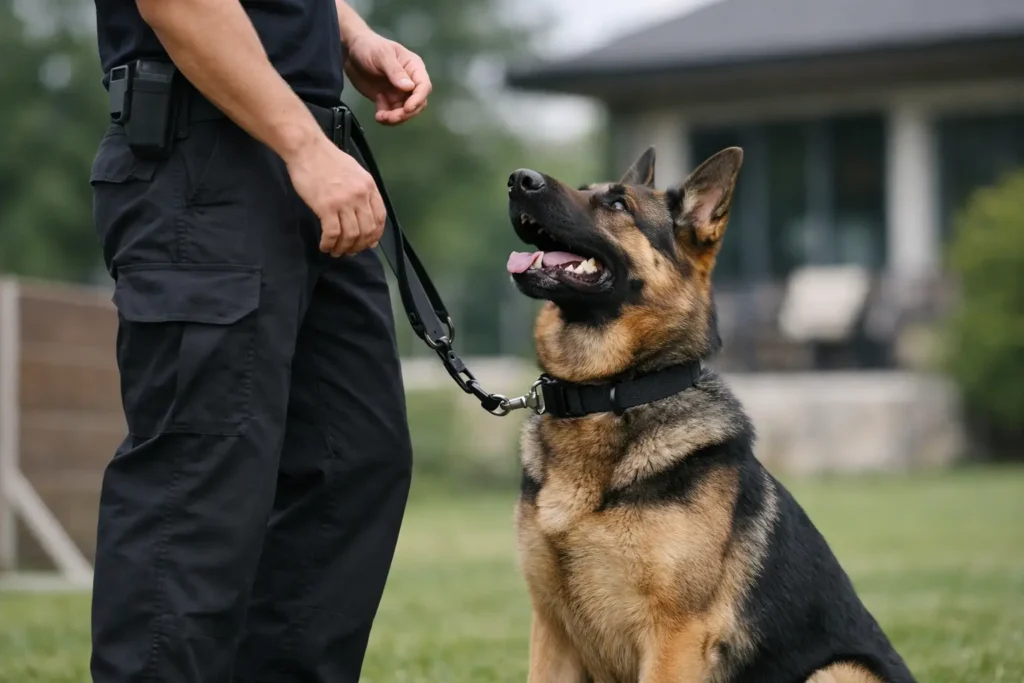
The difference shows up in ordinary moments. A child opens the front door too quickly. Guests arrive unexpectedly. A late-night walk feels a little too quiet. In each of those situations, a protection dog with obedience training is not meant to create tension inside the home. The right dog brings the opposite – calm control, steady companionship, and a level of confidence that fits naturally into daily life.
For discerning families, that distinction matters. Many people are not looking for a dog that appears intense, difficult to handle, or disconnected from real household life. They want a companion that can settle in the living room, travel comfortably, move through public settings with composure, and still provide meaningful deterrence and protection if a situation truly calls for it. That balance is what separates a well-matched protection companion from a dog that is simply trained to react.
What a protection dog with obedience training really means
A true protection companion should be defined by control before capability. Protection may be the headline, but obedience is what makes that protection useful, safe, and livable. Without advanced obedience, even an impressive dog can become stressful to own. With it, the dog becomes part of the rhythm of the household.
This is where many buyers benefit from slowing down and asking a better question. Rather than asking whether a dog can protect, ask whether the dog can protect while remaining stable around children, guests, daily routines, and travel. Ask whether the dog can shift from watchful presence to quiet companionship without friction. Ask whether the dog is trained to respond to its handler with clarity instead of operating on nerve or excitement.
That standard matters because most families do not need chaos. They need assurance. They want a dog whose presence alone discourages bad intent, and whose training supports reliable control when the environment changes.
Why obedience is the foundation of real-world protection
In practical terms, obedience is what allows security to blend into normal life. A protection dog that heels cleanly, recalls promptly, settles on command, and remains composed under pressure is a dog that can live where you live. That means inside the home, around family routines, near visitors, and in the kinds of unpredictable environments that are part of modern life.
This is also why obedience is not a cosmetic extra. It is the framework that allows protection to remain selective and appropriate. A dog should not create liability, social strain, or uncertainty. It should offer confidence through clear handling and stable behavior.
For many households, the ideal dog is companion first in day-to-day living and protector only when genuinely needed. That does not make the dog any less capable. It makes the dog far more valuable. A dog that can only perform in a narrow context is limiting. A dog that can integrate into family life while maintaining protective reliability is far more aligned with what sophisticated buyers are actually seeking.
Deterrence often begins before action
One of the most overlooked benefits of a well-trained protection dog is presence. Composure, structure, and visible attentiveness create natural deterrence. Most people with bad intentions are looking for easy opportunities, not resistance.
That means the dog’s value is not measured only by what happens in a worst-case scenario. It is also measured by what never happens because the dog was there. A stable, obedient protection companion can change the tone of a moment long before any escalation occurs.
The lifestyle fit matters as much as the training
A common mistake in this space is focusing too heavily on capability while underestimating compatibility. Training alone does not determine success. Placement matters. Temperament matters. Household fit matters.
A family with young children has a very different daily pattern than a single executive who travels often. A private estate presents different needs than a full-time urban residence. Some clients want a dog that accompanies them broadly. Others want a dog centered primarily around home life. The best result comes from matching the dog’s disposition and training to the client’s actual environment, not an imagined one.
That is why selective placement has value. It protects the long-term experience for both the family and the dog. When a dog is chosen with care, the result feels natural rather than forced. The dog is not a project to manage. It is a trusted presence in the household.
What discerning buyers should look for
If you are considering a protection dog with obedience training, polished presentation should never be enough. The real question is whether the dog is stable, social, responsive, and suitable for close daily living. That means evaluating the quality of the dog’s manners, its ability to settle, its responsiveness under distraction, and the consistency of its behavior across environments.
It also means looking beyond bold claims. Strong marketing can make many dogs appear interchangeable. They are not. The difference is often in the details buyers feel later – how the dog handles transitions, how it behaves with guests, whether it can travel without drama, whether it remains clear-headed instead of overstimulated.
Health and stewardship matter just as much. A premium placement should come with more than delivery. It should include thoughtful guidance before the match, confidence in the dog’s condition and training, and continued support after placement so the relationship stays successful over time.
Not every trained protection dog is right for a family
This is one of the most important trade-offs to understand. Some dogs are highly capable in controlled demonstrations yet poorly suited to refined household life. Others are beautifully social but lack the seriousness required for meaningful deterrence. The right dog sits in the middle – affectionate, clear-headed, obedient, and credible.
That balance is difficult to produce and even harder to match well. It requires selectivity, experience, and honest guidance. For the buyer, this is where discretion and expertise matter more than volume.
Daily life should feel easier, not heavier
The best protection companions do not make the family adapt around instability. They reduce friction. They bring structure to walks, predictability to the home, and confidence in environments that might otherwise feel uncertain.
That ease matters because luxury, in this category, is not just about acquiring a trained dog. It is about receiving a dog that already understands how to live well with people. A dog that can move from the driveway to the family room to a trip away with poise is far more valuable than one that feels impressive only in staged moments.
For many clients, the emotional benefit is just as significant as the security benefit. There is comfort in knowing your dog is both affectionate and reliable. There is reassurance in seeing children bond with the dog while also knowing the dog’s presence adds a layer of protection. There is peace of mind in having a companion whose training supports the way you actually live.
Why long-term support changes the outcome
Even the right dog benefits from the right handoff. Families need clear guidance on routines, handling, commands, transitions, and expectations. That early support often shapes whether the placement feels effortless or unnecessarily stressful.
The strongest providers understand that their responsibility does not end at delivery. Ongoing stewardship protects the investment and, more importantly, supports the bond between dog and family. It allows small questions to be addressed before they become larger issues. It also gives clients confidence that they are not navigating a specialized category alone.
This is especially important for first-time protection dog owners. Many are highly capable professionals, but they are new to living with a dog trained for both companionship and security. A founder-led, relationship-based approach brings clarity and trust to that process in a way mass-market sellers often cannot.
At High Class K9, that standard of thoughtful placement and continued support is central to the experience. It reflects a simple belief: the right dog should strengthen everyday life, not complicate it.
Protection should feel integrated, not intrusive
The right protection dog with obedience training does not turn a home into a security zone. It turns the dog into a calm, trusted part of the household who happens to offer a very rare level of reassurance. That is a meaningful difference.
For the right family, the value is not only in what the dog can do. It is in how naturally the dog belongs – close to the people it protects, easy to live with, and steady enough to bring confidence to the moments that matter most.